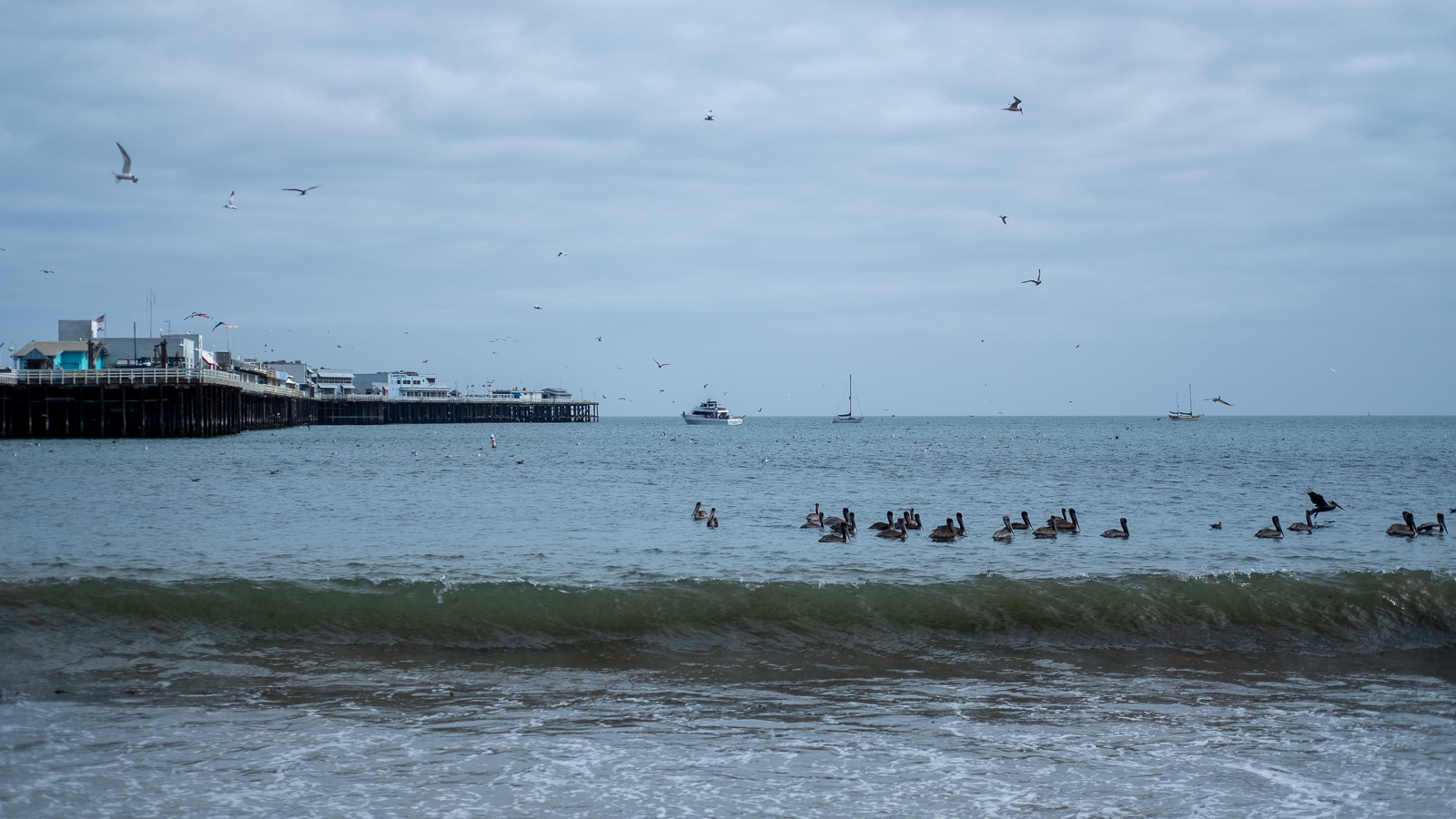
Birds and fishermen alike frequent the Santa Cruz Municipal Wharf. (Nik Altenberg — Santa Cruz Local)
SANTA CRUZ >> On Aug. 20, Connie Maschan rushed to New Brighton State Beach on a rescue mission. A volunteer with Live Oak-based wildlife rehabilitation clinic Native Animal Rescue, Maschan was responding to a call about birds in need of help.
At the beach she found an exhausted-looking brown pelican slumped on the sand, entangled in fishing line and with fish hooks lodged in the back of its neck. As Maschan looked closer, she saw there were three more birds ensnared with the pelican — they were sooty shearwaters, an oceangoing seabird related to albatrosses, and two were dead.
Netting the birds with the help of a park ranger, she cut the fishing line and transported the birds back to the clinic on 17th Avenue. Native Animal Rescue is the only facility in the county licensed to care for injured seabirds.
Six days later, Maschan was back at it. First, it was a common murre, sometimes called “flying penguins” but more closely related to puffins, ensnared by fishing tackle at Capitola Wharf. Then a pelican and a gull that were entangled together in fishing line on the San Lorenzo River near the Boardwalk, and hauled to shore by a surfer.
On Dec. 5, a surf scoter — a type of sea duck — was found hooked on the face and foot at Platforms Beach in Aptos, and a pigeon was found caught in fishing line and dangling upside down from Santa Cruz Wharf.
By that point, Native Animal Rescue had treated 48 birds this year for fishing gear-related injuries, about the same number that it treated in 2024. The number does not include birds that were found dead or birds freed by fishermen.
Though no public California piers are entirely immune to fisherman-bird conflict, Santa Cruz County is a hotspot, according to a 2016 report from International Bird Rescue, which called it “the source of a surprisingly large number of [fishing line and hook] injuries for a relatively small geographic area.”
The report noted, for example, that 229 brown pelicans were found with fishing-gear related injuries in the Santa Cruz area from 2002 to 2015, compared to 26 in San Francisco and three in Oakland in that same time period.
Santa Cruz officials have taken some steps over the years to curb the problem. In 2001, fishing was temporarily closed on much of the Santa Cruz Wharf after dozens of pelicans were hooked or entangled. The Capitola Wharf and Seacliff piers were also temporarily closed after a spate of pelican injuries in 2008. And in 2007 and 2008, volunteer scuba divers removed more than 1 million feet of fishing line from the Santa Cruz Wharf and 14 other California piers.
Many Santa Cruz fishing locales have educational signs and receptacles for used fishing gear to be properly disposed of. “Our teams also conduct periodic shoreline checks and cleanup efforts to help reduce entanglement risks for local wildlife,” said Mike Godsy, superintendent of parks for the city of Santa Cruz, in a Dec. 10 email.
Nonetheless, bird advocates said local fishermen could do more to clean up after themselves and heed best practices.
“If at all possible, they should not be leaving any line or hooks around,” said Eve Egan, executive director of Native Animal Rescue. Ensnared birds represent only a small fraction of the roughly 3,000 wild animals brought to Native Animal Rescue each year. But compared to, say, illness and starvation, she said, fishing entanglements could be easily prevented.
Best practices for fishing
Ken Jones, author of a guide to pier fishing in California, said almost no anglers intentionally hurt birds, and most want to do the right thing by them. “But you’re always going to get a certain percentage of people who either don’t know or don’t care,” Jones said.
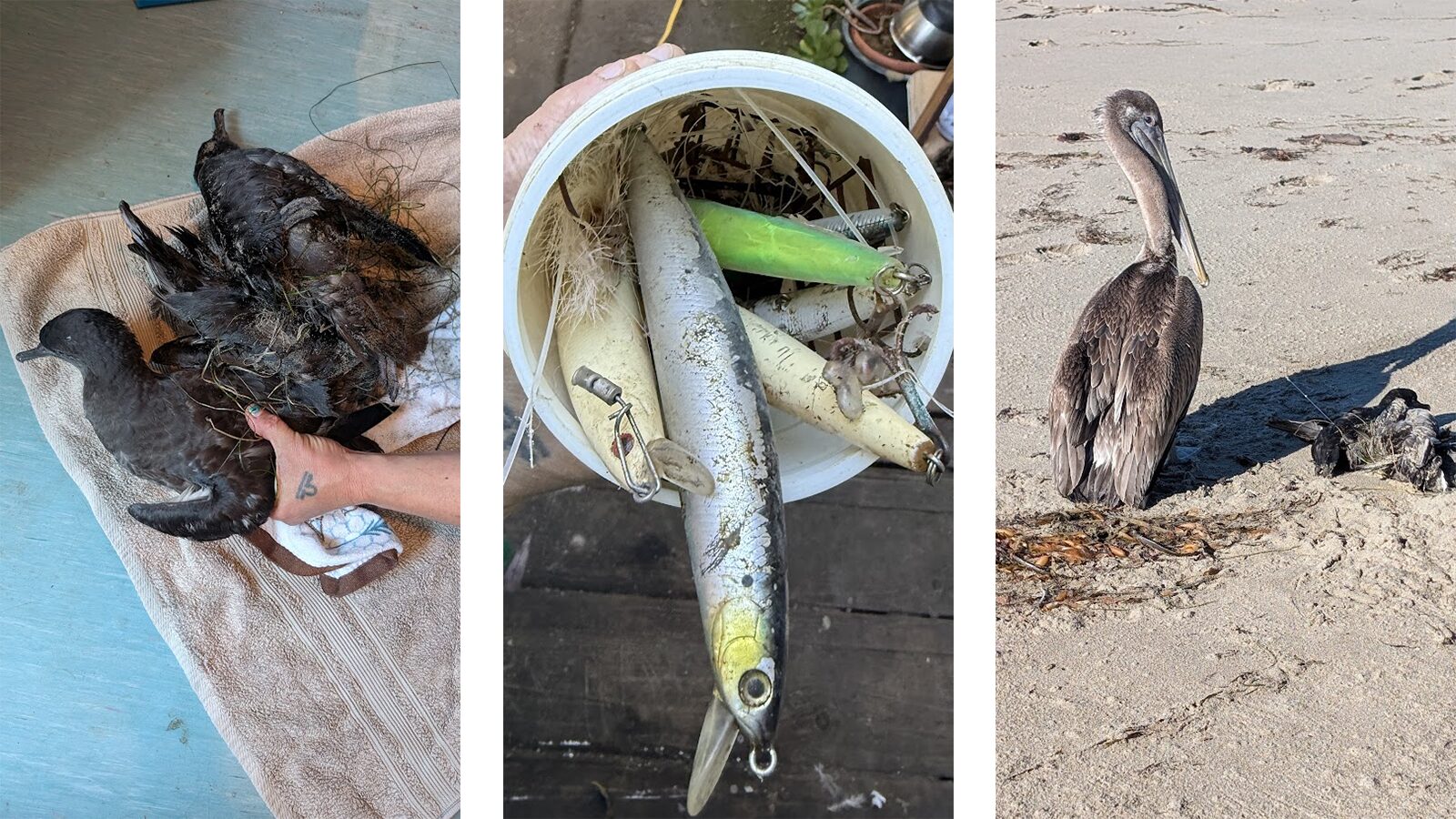
The entangled pelican and shearwaters that Maschan picked up on Aug. 20, along with hooks and lures volunteers with Native Animal Rescue have collected from birds. (Connie Maschan — Contributed)
He said everyone should “leave the pier as clean as possible” after fishing. To prevent snags, as well as injuries to both people and animals, Jones said pier fishermen should use shorter rods and cast underhand. The federal government’s NOAA marine debris program likewise advises not casting in areas where lines might get tangled, among other tips.
If a bird is hooked, Jones recommended reeling it in, covering it with a towel to calm it and then if possible removing the hook. Egan of Native Animal Rescue agreed that this is often the best method, though she cautioned that if not done correctly it can cause more harm. If it’s unclear how long it has been hooked or entangled, she said, “it’s best to bring the bird to us.”
“It might be starving and need intervention,” Egan said. She added fishermen should never cut the line and allow the bird to escape with fishing gear still attached.
Jones, who lives in Fresno, said he comes to fish from the Santa Cruz Wharf and other Monterey Bay piers about twice a year. He said the wharf is good for halibut in summer and perch in spring. In general, fishing from public piers is family friendly and relatively inexpensive, Jones said, and a fishing license isn’t needed.
Sea lions and divers and birds
Most seabirds that Native Animal Rescue treats are sent for further care to International Bird Rescue, which runs wildlife rehabilitation clinics in Fairfield and Los Angeles. These clinics have pools and bigger cages, allowing the birds to resume flying and swimming in safe conditions.
Rebecca Duerr, veterinarian and research director at International Bird Rescue, estimated that about half the birds she treats are injured by fishing gear. She compared monafilament — the most popular kind of fishing line — to a tourniquet.
“It can kill the limb, it can cause amputations, it can sever tendons,” Duerr said. “It does all sorts of nasty stuff to their legs.” Braided, or Spectra, line might be even more abrasive to wildlife, a 2010 case study found.
Fish hooks also “cause a tremendous amount of carnage,” Duerr said, adding that lures with multiple three-pronged hooks were the worst. One pelican in Orange County was found in spring 2024 with a hook through its genitalia.
Pelicans are the bird most often brought in for treatment. Earlier this year, Duerr co-authored a report documenting 1,067 brown pelicans that entered rehabilitation in spring 2024 during a mass stranding event. Starvation seemed to be the main issue, but 194 of the pelicans also had fishing gear-related injuries, including 49 in Santa Cruz County.
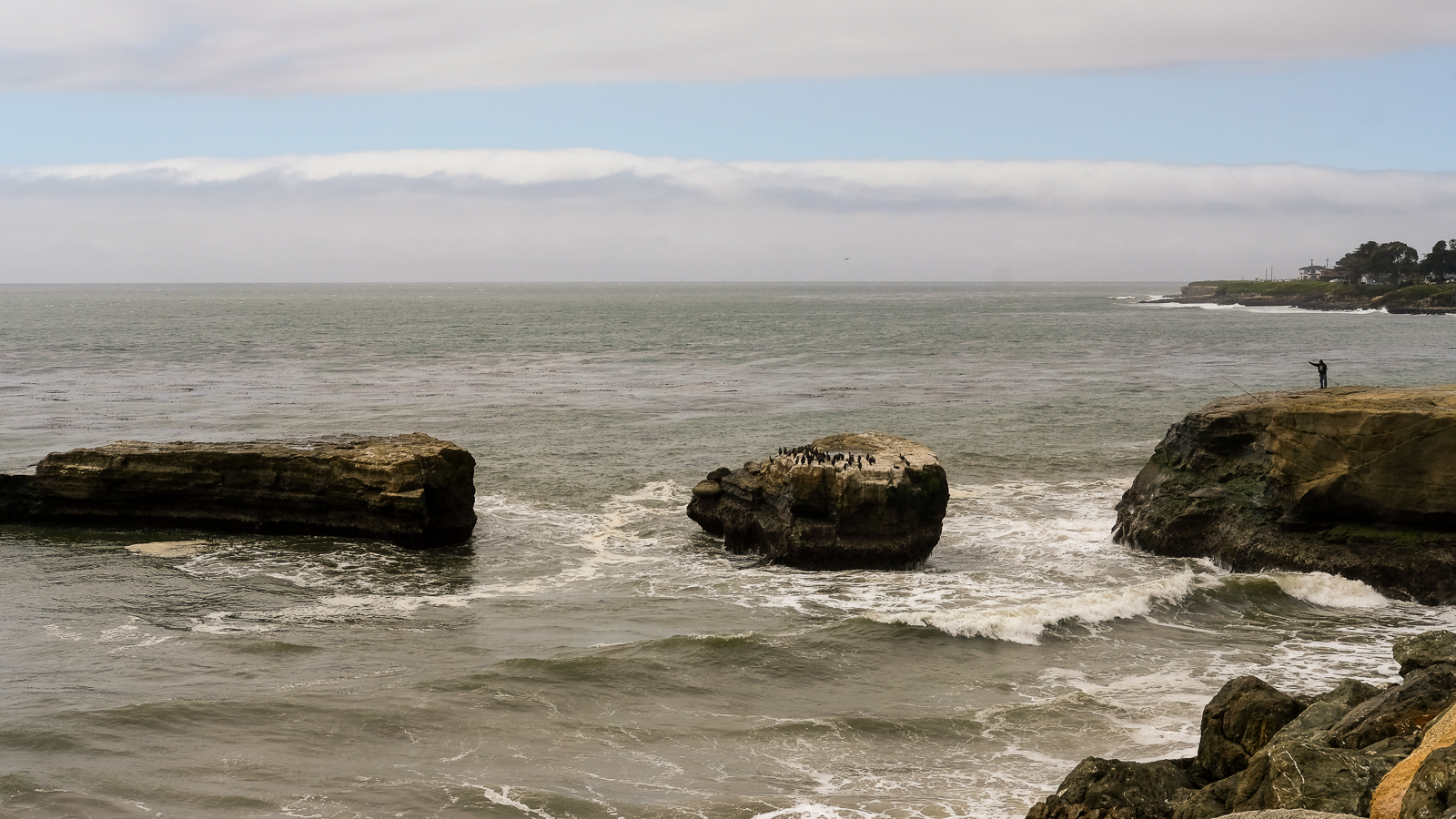
A man fishes from West Cliff in Santa Cruz near a group of cormorants. (Nik Altenberg — Santa Cruz Local file)
Duerr suspects that when food is scarce, pelicans engage in riskier foraging behavior that brings them closer to humans. The report asserted that pelicans don’t generally bite baited hooks, but are rather snared accidentally where people are fishing.
Marine mammals are also at risk from fishing gear, said Giancarlo Rulli, a spokesperson with the Marine Mammal Center in Marin County, which takes in injured marine mammals from across much of California.
Rulli said in an email on Dec. 9 that seals, sea lions and sea otters are “intelligent and curious” and that they “can see ocean trash and plastics as something to eat, investigate or play with — not knowing that this new object could end up being fatal.” Rulli added that young animals appear especially susceptible.
Meanwhile, whales and other animals in Monterey Bay are sometimes entangled either by active commercial fishing gear or lost or discarded fishing gear — also called “ghost gear.”
In addition to harming wildlife, discarded gear can destroy boat propellers and on rare occasions kill people, such as a scuba diver who drowned in South Carolina in 2017 after fishing line got snared in her breathing apparatus.
How the injured birds fare
At International Bird Rescue, the ultimate goal is to release the birds back into the wild.
“I want them to be able to go out there and make babies and push their genetics into the future,” Duerr said. However, many birds die after being taken in. Others are euthanized because they can no longer survive on their own.
“No one wants a disabled gull as a zoo animal, unfortunately,” she said. She lamented that International Bird Rescue couldn’t find a home for a one-eyed albatross, though she said it did place a snowy plover with the Monterey Bay Aquarium and a white-faced ibis with the Aquarium of the Pacific in Long Beach.
She said she “can treat some pretty bad injuries” and that she’s “had some pretty amazing recoveries.”
The pelican found on Aug. 20 at New Brighton State Beach, for example, was nursed back to health and released on Oct. 2 at Fort Baker in Marin County. But the lone surviving shearwater attached to it was euthanized, as were the murre and gull picked up six days later.
As for the surf scoter collected on Dec. 5, Egan said, “We think it’s going to be OK.”
To learn more about what to do if you encounter an injured seabird, visit Native Animal Rescue’s website.
Questions or comments? Email [email protected]. Santa Cruz Local is supported by members, major donors, sponsors and grants for the general support of our newsroom. Our news judgments are made independently and not on the basis of donor support. Learn more about Santa Cruz Local and how we are funded.

Jesse Greenspan is a freelance journalist who writes about history, science and the environment. His work has appeared in The New York Times, Scientific American, Audubon and other publications.