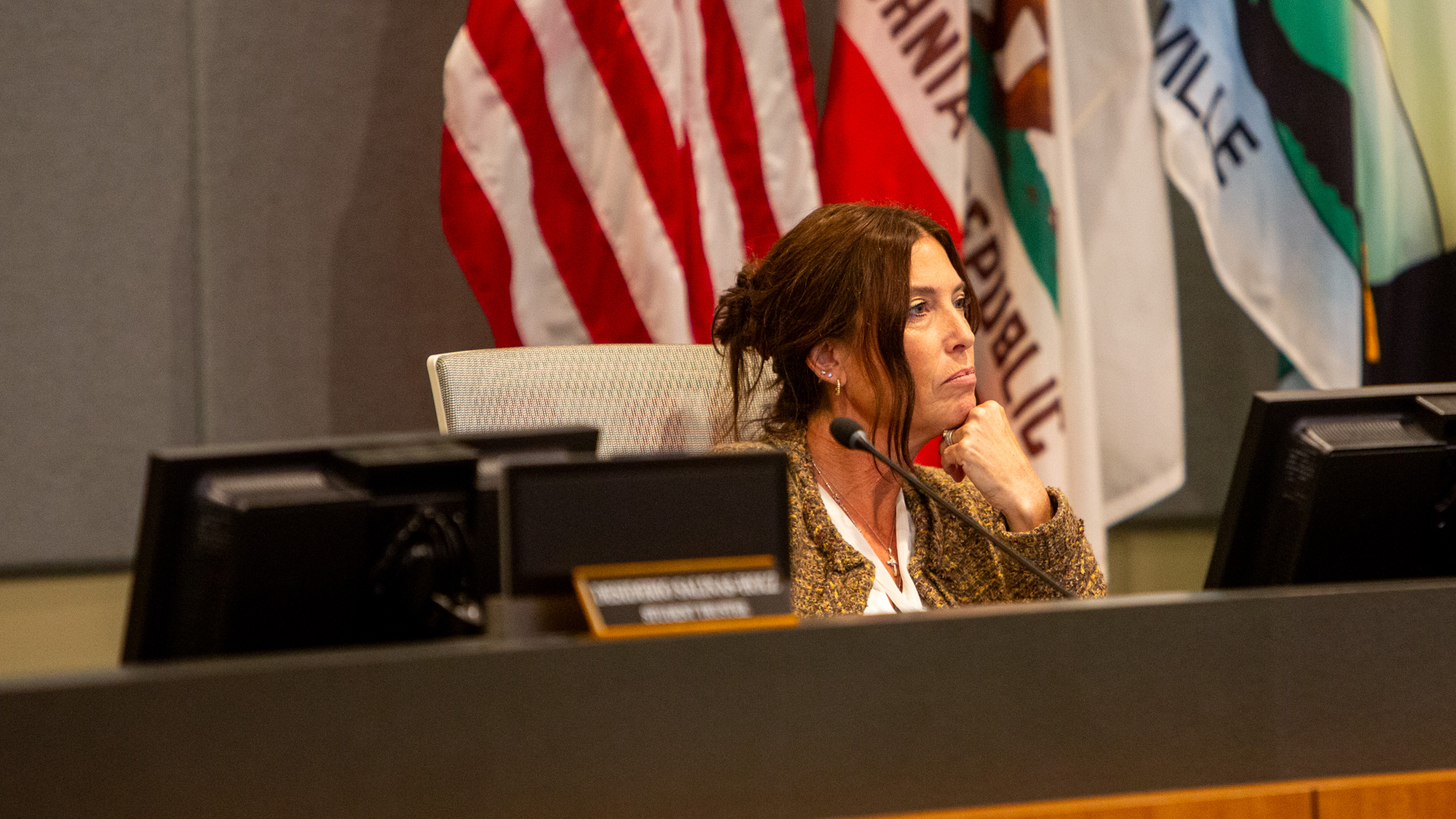
Pajaro Valley Unified School District Superintendent Dr. Heather Contreras listens as community members speak at a PVUSD Board of Trustees meeting in Watsonville on Oct. 22, 2025. (Amaya Edwards — Santa Cruz Local/CatchLight)
WATSONVILLE >> Pajaro Valley Unified School District trustees hit the brakes on changing a board policy governing controversial topics after backlash from teachers, parents and residents.
The “Controversial Issues Board Policy” defines how educators should address topics of “religious, political, social, economic, ethical or moral significance,” according to the policy. It was scheduled for approval on the consent agenda at Wednesday’s Board of Trustees meeting, but was pulled out for discussion by Board President Olivia Flores after backlash from residents and trustees concerned about classroom censorship.
More than a dozen public speakers called for the policy to not be approved until there was more time for review and more opportunities for district residents’ input. Multiple people took issue with the policy requiring teachers to consult with the “Superintendent or other designee” on controversial issues and that “all sides” of a topic be presented to students.
“I don’t have a problem with having a policy on controversial items, but I do have a big problem with who gets to define what controversial items are and how policies are implemented,” said Gabriel Barraza, a parent and co-founder of Pajaro Valley for Ethnic Studies and Justice.
Multiple commenters suggested the policy revision was connected to Watsonville activist Omar Dieguez and his month-long hunger strike to protest the use of pesticides near schools in Pajaro Valley. He previously told Santa Cruz Local that two speaking events at district schools were cancelled last month, despite him complying with the district’s controversial topics policy.
Amidst the controversy and media coverage ahead of the meeting, Superintendent Heather Contreras sent an email Wednesday and said the policy change was part of a routine update. Several attendees of the meeting said this downplayed the policy revision’s importance.
“I’m not against guidelines, I’m not against helping teachers navigate difficult topics, but policies like this should be written through partnership with teachers, with students, with family, and with community members,” said Bobby Pelz, an ethnic literature studies teacher at Watsonville High School. “That’s what transparency looks like.”
Flores apologized for not originally scheduling the policy revision for discussion. She clarified that Contreras had recommended it be scheduled for discussion, but that the board’s agenda setting committee instead decided to add it to the routine approvals. She said future policy updates will have ample time for public comment.
Assistant Superintendent Claudia Monjaras said the controversial issues policy hasn’t been updated since 2009. That’s not uncommon, according to Trustee Misty Navarro, who said many of the district’s policies haven’t been revisited since 2009 or earlier.
“It just so happened that this policy came up and gave us the opportunity to look at the policy, it was not nefarious,” Navarro said at the meeting.
Trustees also said they don’t want to supersede teachers in the classroom and will be looking for updates in the policy’s second read to ensure teachers and parents have more autonomy while still establishing guardrails.
“When I was reading it I was thinking, had I been on the other side and still been a teacher, I could see why a lot of teachers would be upset about this,” Trustee Jessica Carrasco said. “Now with this feedback that we’re getting, we’re maybe able to create something else that better fits everybody.”
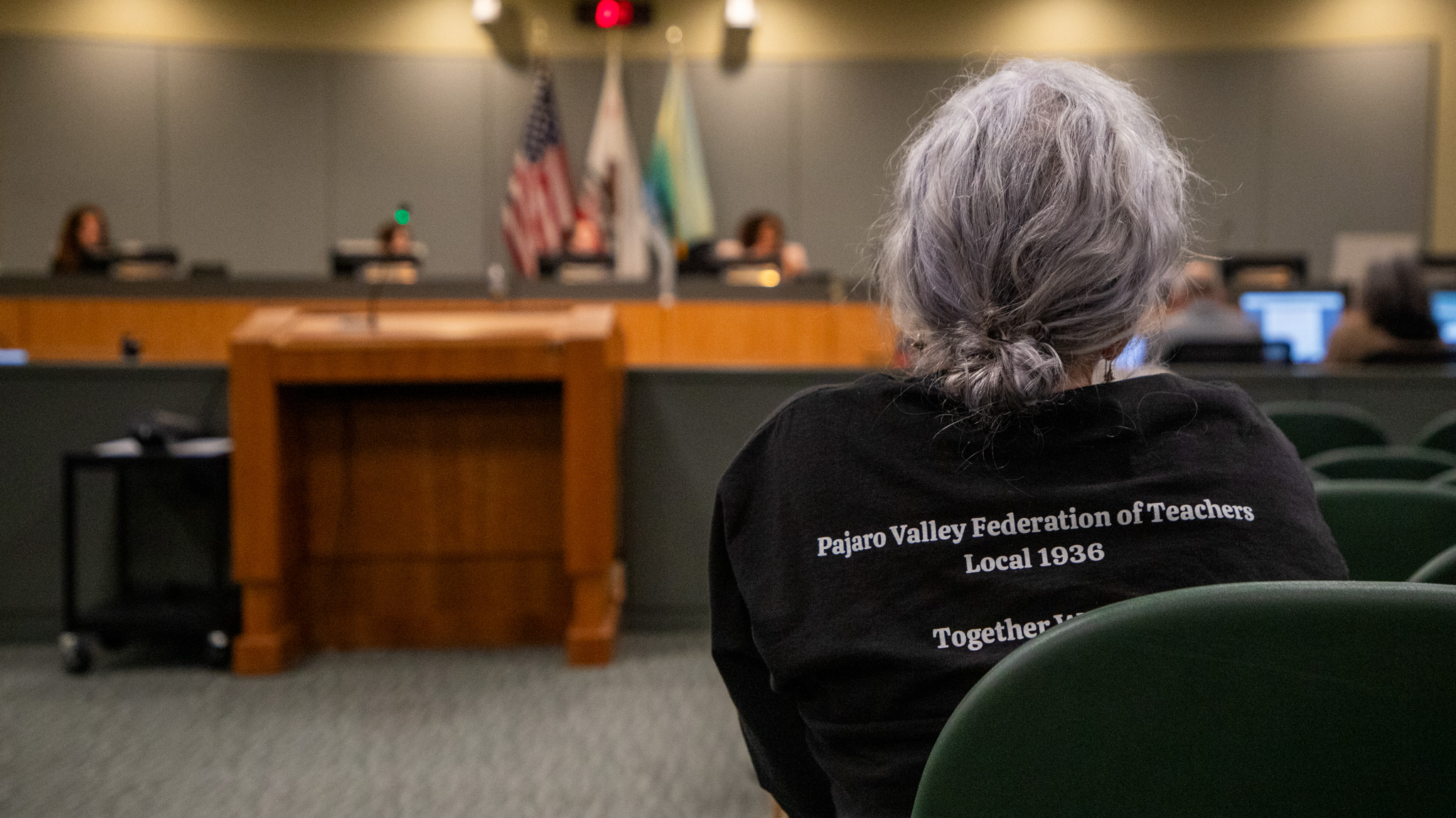
An educator sits in the audience as discussions focus on a disputed policy governing controversial topics during a Pajaro Valley Unified School District Board of Trustees meeting in Watsonville on Oct. 22, 2025. (Amaya Edwards — Santa Cruz Local/CatchLight)
Board scores 0/100 on ‘effectiveness’
At the meeting, the board also underwent its first self-evaluation — and scored 0 out of 100.
Led by Greg Klein, a school board governance coach with consulting company Effective School Boards, the self evaluation included several categories with the board of trustees grading themselves.
Klein discussed guidelines for good governance and said the goal of the evaluation is to improve student experience and outcomes by streamlining, clarifying and unifying district processes.
Areas of improvement included listening sessions and clarifying board and Superintendent responsibilities. The board scheduled community listening sessions at various schools through October and November.
Dieguez, the activist who completed a hunger strike last month, said he feels the board doesn’t listen to residents’ concerns.
“They need to hold these listening sessions, hear the community, and come back and decide what to do,” Dieguez said. “If they don’t do that, then they’re silencing the community. They’re saying ‘we don’t care.'”
Trustee relations also came into focus as part of that evaluation and more so in trustees’ responses to the backlash. Flores and Navarro likened some of the response to “bullying,” including an email received by district officials with an “offensive caricature” of Contreras.
The school district and its trustees aren’t strangers to controversy. Last year, trustees faced public criticism over their decision to not renew ethnic studies curriculum and lack of community engagement. In the fall, three new trustees were voted to the board, with a fourth joining later in a special election.
“With this policy and with all board items, we need to focus on making decisions that are in the best interest of our students and their learning,” Flores said. “We should have our discussions and a debate here at a public board meeting.”
The controversial issues policy will be coming back for a second read in a future meeting, and potentially forming a committee of trustees, students and teachers to weigh in on future policy revisions. Brandon Diniz, president of the Pajaro Valley Federation of Teachers 1936, said they will be looking out for the next version of the policy to see how the community’s concerns have been taken into consideration and how the board proceeds.
“Either in three weeks, this is going to come back and it’s going to remain unchanged and they’re just going to stick with it, or it’s going to come back with hopefully some option with input [from the community],” Diniz said.
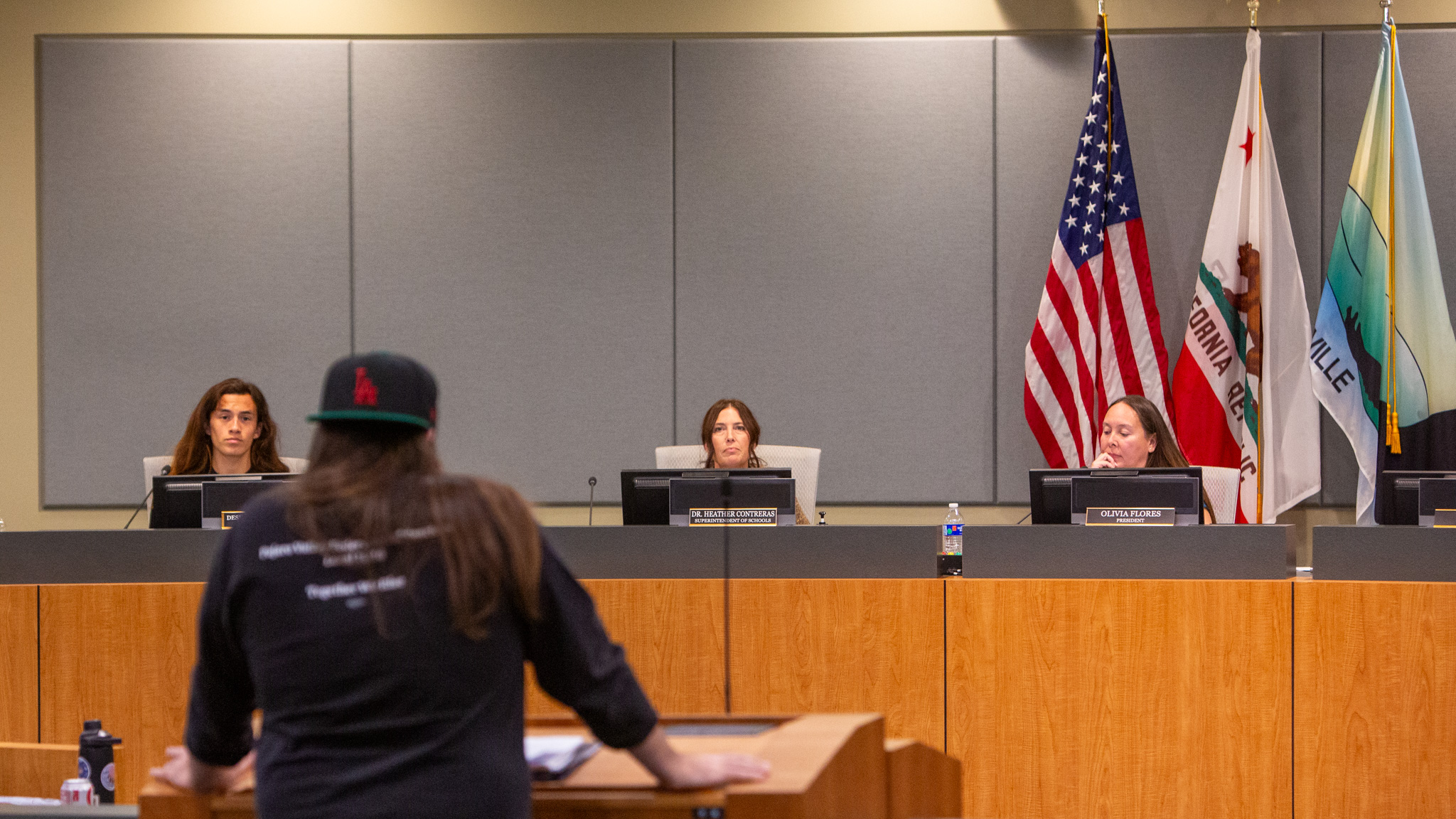
Brandon Diniz, president of the Pajaro Valley Federation of Teachers 1936, speaks out against the proposed policy governing controversial topics during public comment at a Pajaro Valley Unified School District Board of Trustees meeting in Watsonville on Oct. 22, 2025. (Amaya Edwards — Santa Cruz Local/CatchLight)
Questions or comments? Email [email protected]. Santa Cruz Local is supported by members, major donors, sponsors and grants for the general support of our newsroom. Our news judgments are made independently and not on the basis of donor support. Learn more about Santa Cruz Local and how we are funded.

B. Sakura Cannestra is a politics and governance journalist based in San Jose. She previously reported for San José Spotlight and POLITICO California. She graduated from UC Berkeley in 2023 with a Master's of Journalism, where she also got her start as an undergraduate in 2016 covering the university and city of Berkeley for the Daily Californian.