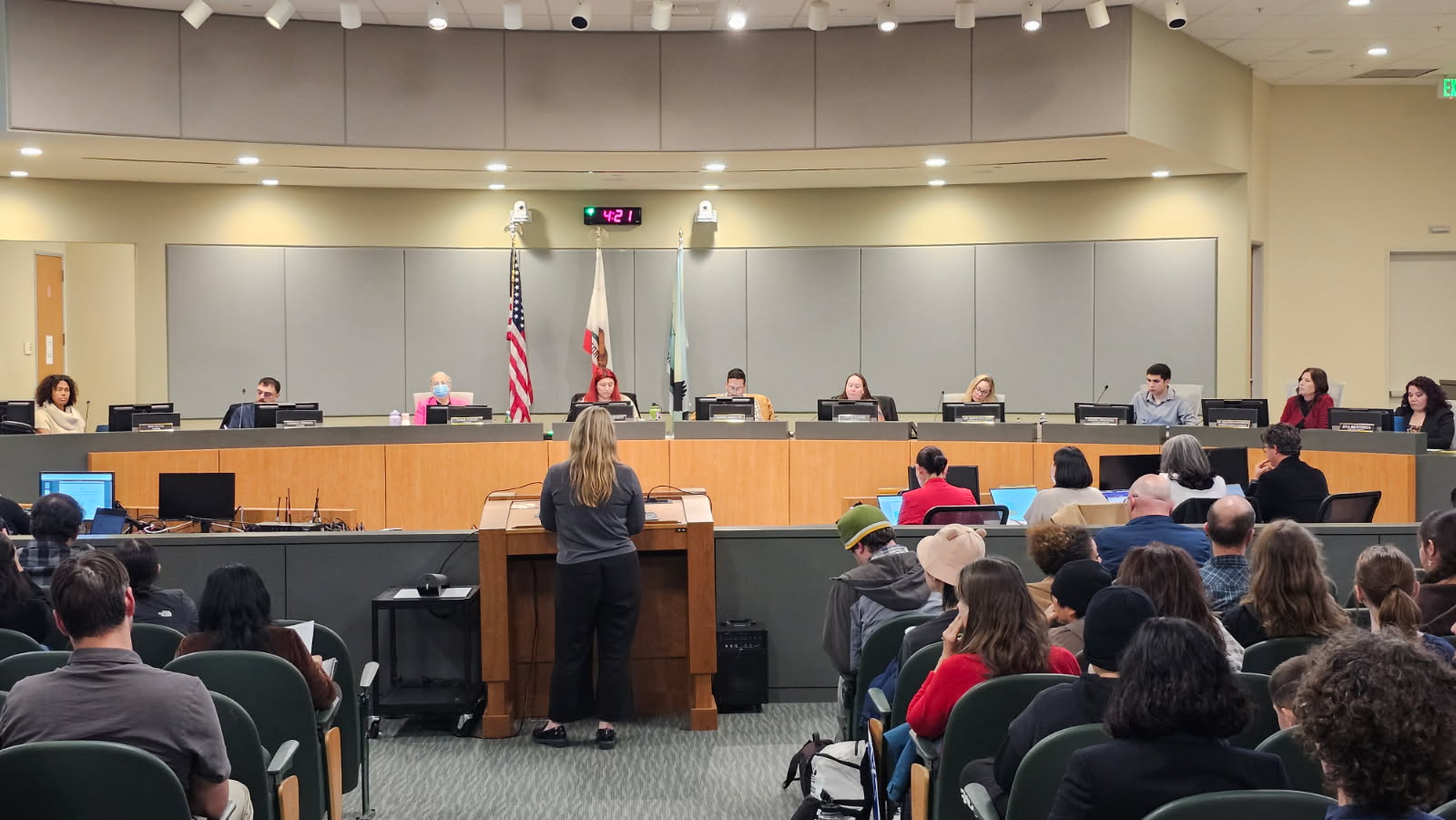
Pajaro Valley United School District is proposing changes to the way educators handle “controversial” topics in the classroom. A board of trustees meeting in February. (Fidel M. Soto — Santa Cruz Local file)
Pajaro Valley Unified School District Board of Trustees meeting
- 6 p.m. Wednesday, Oct. 22 at 275 Main St., fourth floor, Watsonville.
- The meeting will be streamed on YouTube.
WATSONVILLE >> A proposed change to rules about the discussion of “controversial” topics in Pajaro Valley Unified School District is raising concerns over classroom censorship among some trustees.
The ‘Controversial Issues Board Policy’ centers on instruction related to issues “that may arouse strong reactions based on personal values and beliefs, political philosophy, culture, religion, or other influences,” according to the revised policy.
The changes to the policy instruct teachers to consult the district superintendent on the appropriateness of a controversial topic. It also gives the superintendent the power to instruct teachers to “refrain from sharing personal views in the classroom on controversial topics.”
“It puts so much authority in the hands of the superintendent of what to approve and what’s too controversial to be taught,” said Brandon Diniz, president of the Pajaro Valley Federation of Teachers 1936. “I see it as a rolling back of our ability as educators to determine what can be presented to our students and the ways in which we can do that.”
The item is on the consent agenda for Wednesday’s Board of Trustees meeting, which means it will not be formally discussed by trustees unless it’s pulled to the regular agenda.
The policy was first adopted in 2010. Although the board is supposed to review these policies every three years, this is the first time revisions have been made in 15 years.
‘Opposing viewpoints’
Trustee Gabriel Medina got a hunch that changes to the policy might be happening when Watsonville activist Omar Dieguez’s planned visit to Watsonville High and Pajaro Valley High were cancelled in September. Dieguez participated in a month-long hunger strike to protest the use of pesticides near schools in the Pajaro Valley.
“This first got on my radar when I asked the superintendent why Omar was not allowed to come to our schools to spread awareness when other districts were welcoming him with open arms,” Medina said. “All I was told by the superintendent is that they were updating this policy that would put new guidelines in place for guest speakers.”
The new policy states that when a guest speaker is invited to make a presentation related to a controversial issue, the superintendent is responsible for first making them aware of the policy. Then, if the guest speaker is presenting only one point of view on an issue, the host teacher is responsible for ensuring that students also receive information on opposing viewpoints.
In planning for his presentation at Pajaro Valley High, Dieguez told Santa Cruz Local the principal required he be fingerprinted, submit the presentation for review, get permission slips for parents to approve and invite Driscoll’s representatives to hear from both sides of the debate. Dieguez and others targeted Driscoll’s and called on the multinational berry company to transition its fields near schools to organic.
Despite complying with the requirements, Dieguez said his visit was cancelled.
Like Diniz, Medina said he fears how much power the revisions would give to the superintendent’s office to decide what is considered controversial.
“It’s going to have a chilling effect on teachers and that feels like a giant case of censorship,” Medina said.
Superintendent Heather Contreras did not respond to a request for comment.
Student Trustee Desi Salinas-Holz, 17, said he was first alerted to the item by his mom, who read the agenda and pointed out the Controversial Issues policy revisions. He said after reading it he was shocked, and that his Watsonville High School classmates were talking about it, where Salinas-Holz is a senior.
As the vice president of the Gender & Sexuality Alliance at his school, Salinas-Holz said he is especially concerned that parts of this new policy — like presenting all sides of a topic — might inadvertently rollback progress in educating his generation about LGBTQ+ issues.
“I think that would bring a lot of hate into the classroom, because the opposing viewpoint can make a lot of students feel unsafe and uncomfortable,” Salinas-Holz said. “The opposing viewpoints of LGBTQ+ would be directly hurtful to students who might identify as that.”
Despite his worries, Salinas-Holz said he has high hopes that the board will move the item off the consent agenda and allow an open discussion for everyone to participate in.
“I want my fellow trustees to really see that this is something that’s not okay with a lot of students and teachers, and that there needs to be more discussion,” he said.
Questions or comments? Email [email protected]. Santa Cruz Local is supported by members, major donors, sponsors and grants for the general support of our newsroom. Our news judgments are made independently and not on the basis of donor support. Learn more about Santa Cruz Local and how we are funded.

Alexandria Bordas is the Managing Editor at Santa Cruz Local. She is an award-winning investigative journalist and editor. She worked as a reporter on the San Francisco Chronicle’s Investigative Team from 2020-2023 to report on dozens of sexual assault allegations against a Sonoma County mayor and winery owner. Alexandria was named journalist of the year in 2022 by the Society of Professional Journalists. She is also a professor of journalism.