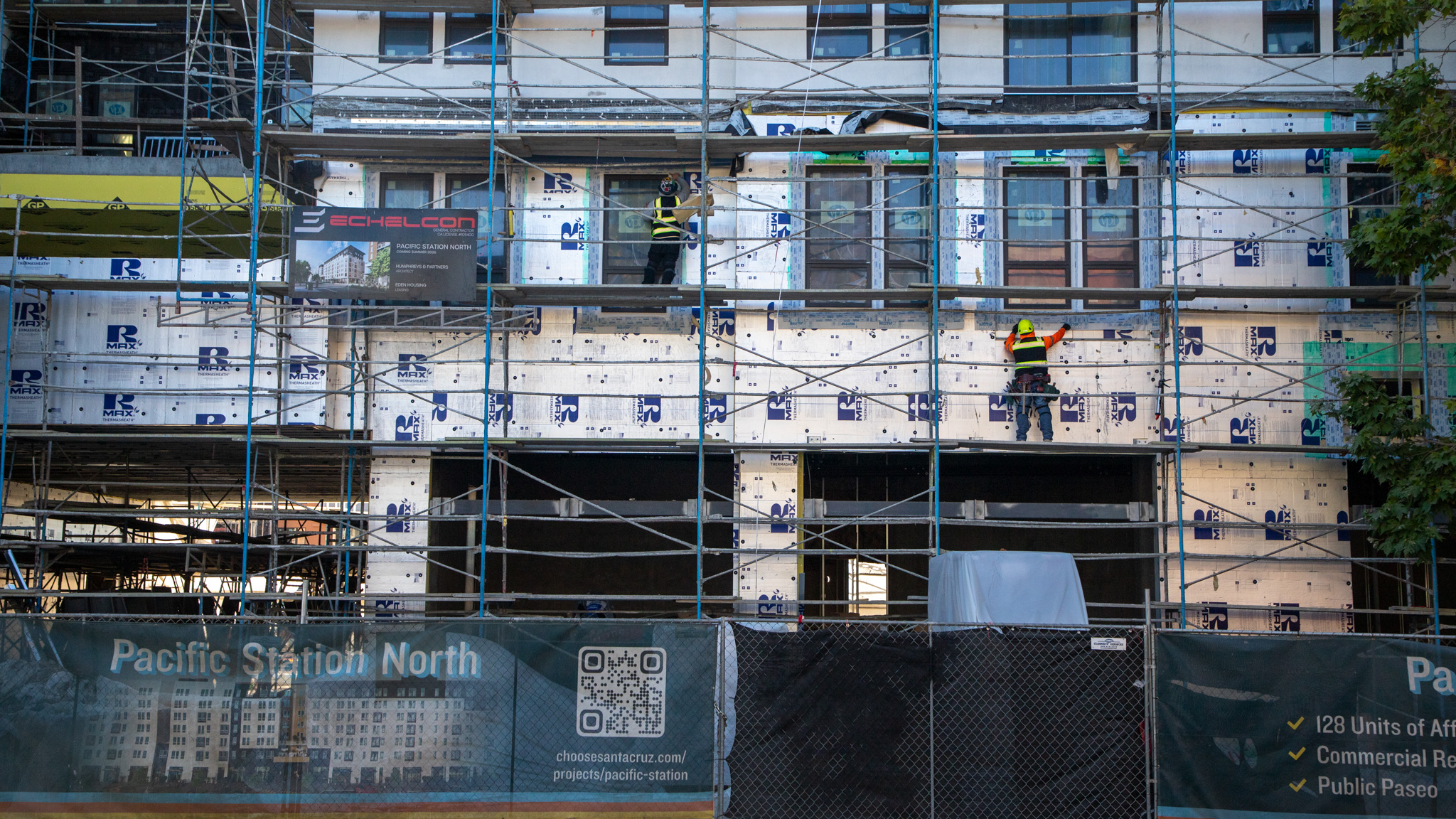
A construction crew works on the Pacific Station North housing development on Aug. 19. (Amaya Edwards — Santa Cruz Local/CatchLight Local)
SANTA CRUZ >> Two new state laws are set to allow many new housing projects in California to skip environmental review by granting exemptions to the California Environmental Quality Act. CEQA has long been used by environmental groups — or anyone who opposes a new development — to stop or delay projects.
Environmental review can be costly, and lawsuits stemming from challenges to the CEQA process can delay a project for years. The new laws are meant to help housing developers expedite or skip the process, regardless of how many units are below-market-rate, to try to address the state’s severe housing affordability crisis.
SB 131 simplifies the environmental review process for all projects and AB 130 essentially ends it for housing projects in urban areas.
“I think it is a step in the right direction toward recognizing that infill housing is good for the
environment,” said Lee Butler, planning director for the City of Santa Cruz. He said CEQA assumes “that new development is creating negative impacts, and in reality new development can be positive.”
Butler added, “It’s going to take a long time for us to build a sufficient number of units to make up for the significant lack of supply.”
Santa Cruz Mayor Fred Keeley said he was not supportive of the new legislation.
“I’m not a big fan of gutting the California Environmental Quality Act for what people think are good purposes,” Keeley said, adding that he doesn’t believe hastening all housing development will necessarily lead to a more affordable housing market. “We’re not going to grow our way to affordability. That’s where the state and I have a disagreement. I don’t believe that.”
California Governor Gavin Newsom pushed the bills through the legislature in June by refusing to pass the proposed state budget unless the laws were also adopted.
Assembly Bill 130:
- Eliminates environmental review for infill housing projects if the property is zoned for the development.
- Pauses changes to local and state building codes until 2031.
- Tightens timelines for the California Coastal Commission to decide on project approvals.
Senate Bill 131:
- Simplifies environmental review for all projects.
- Grants exemptions to CEQA for certain projects, such as rural health centers, child care centers, food banks, parks and high speed rail stations.
- New areas for urban infill development will be mapped out by the state by July 1, 2027 with local governments being able to review and suggest changes.
- For projects that would otherwise be exempt from environmental review but have one disqualifier, the environmental review only has to address the one disqualifying aspect — rather than the entire project.
CEQA and development in Santa Cruz County
One project that may have benefitted from the new rules is 908 Ocean St. in Santa Cruz. After being proposed in 2022, the project faced delays when a building on the site was deemed to have potential historic value. Alongside the potential environmental effects of a development, the CEQA process evaluates impacts on city infrastructure, including historic buildings, traffic and noise.
The project’s developers “spent easily a year and hundreds of thousands of dollars on an environmental impact report,” Butler said. After the 389-unit project was approved by the city in February, the developers reportedly backed out and recently said they would try to shrink the size of the project. Rising production costs and long city approval times could have played a role.
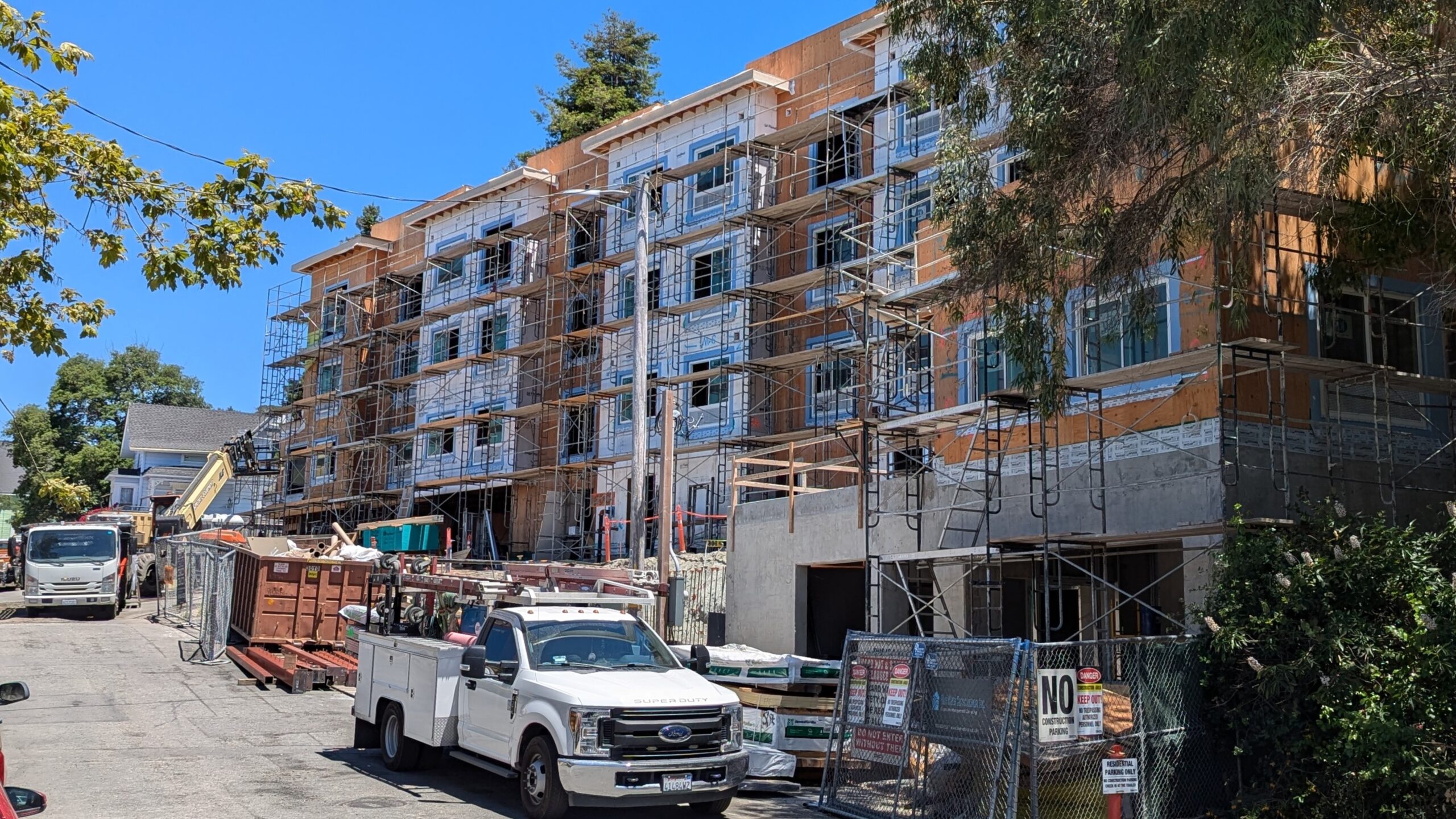
Supportive housing is under construction at 314 Jessie St. in Santa Cruz in June 2024. (Stephen Baxter — Santa Cruz Local file)
Lengthy reviews from the California Coastal Commission, which regulates developments within about 5 miles of the shore, have also bogged down local housing projects.
A 50-unit building for low-income people with disabilities on 314 Jessie St. spent more than a year in limbo, Midpen Housing representative Lyn Hikida wrote in an email, as the nonprofit developer worked to secure a development permit and a CEQA exemption.
The long development time was attributed in part to the project falling within the Coastal Zone regulated by the California Coastal Commission. AB 130 sets a shorter time limit for the commission to make a decision on developments.
Prevailing wages in new developments
The laws could also be a boon to organized labor, and could help speed market-rate developments. Previous laws allowed a project to bypass CEQA if it included a portion of below-market-rate units and paid state-set prevailing wages. The new laws extend the exemption to all projects with 50 units or more that satisfy higher labor standards like paying prevailing wages, including those with little or no below-market-rate housing.
“We have been at a breaking point with housing for quite a while and anything that the state can do to make it easier to build housing is welcome,” said Jason Hoppin, a spokesman for the County of Santa Cruz. “We have not faced a lot of CEQA lawsuits in recent years. Although certainly they come up a lot as a threat.”
The promise of a CEQA exemption could incentivise developers to pay a prevailing wage on certain projects. The NorCal Carpenters Union has criticized San José-based real estate contractor Swenson Builders for paying below state-set prevailing wages on the construction of La Bahia Hotel and Spa in Santa Cruz.

NorCal Carpenters Union members protest outside Swenson Builders’ Downtown Santa Cruz office on May 19. Real estate investment firm Ensemble Investments is the majority owner of La Bahia. (Dave Ordonez — Santa Cruz Local)
One construction worker, who requested anonymity to protect his job, said he worked for Swenson on the La Bahia project and earned about $20 per hour less than the prevailing wage.
Swenson representatives did not address questions about pay on the jobsite, but Mark Pilarczyk, president of development, said he was supportive of the new laws.
The company is “hopeful that this policy change will help shorten the entitlement process, for certain projects, substantially helping to get more housing opportunities throughout the Bay,” he said.
Not everyone is happy with the significant changes to CEQA.
“It’s made out as though frivolous lawsuits are just being thrown out there. When, in fact, it’s one of the few ways that the public can counter the inadequate review of what the impact is on the biodiversity and the environment,” said local environmental and women’s rights advocate Gillian Greensite. “I think that the impact is going to be that we will see more environmental degradation without any review.”
Read more
Questions or comments? Email [email protected]. Santa Cruz Local is supported by members, major donors, sponsors and grants for the general support of our newsroom. Our news judgments are made independently and not on the basis of donor support. Learn more about Santa Cruz Local and how we are funded.

Dave Ordoñez is an undergraduate at UC Santa Cruz. He has bylines in City on a Hill Press for video and print reporting.