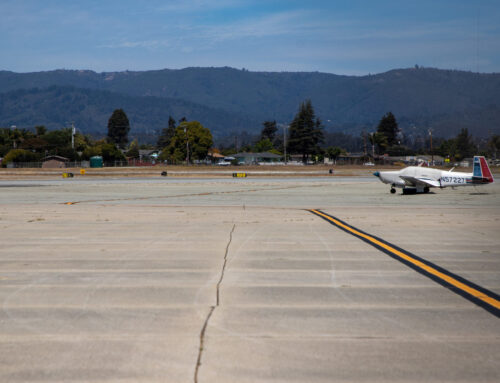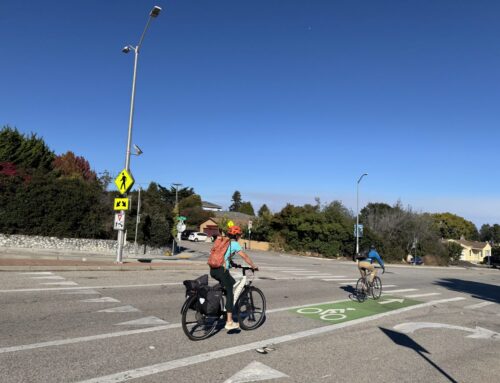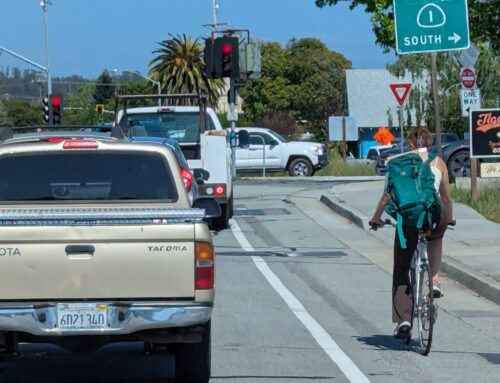
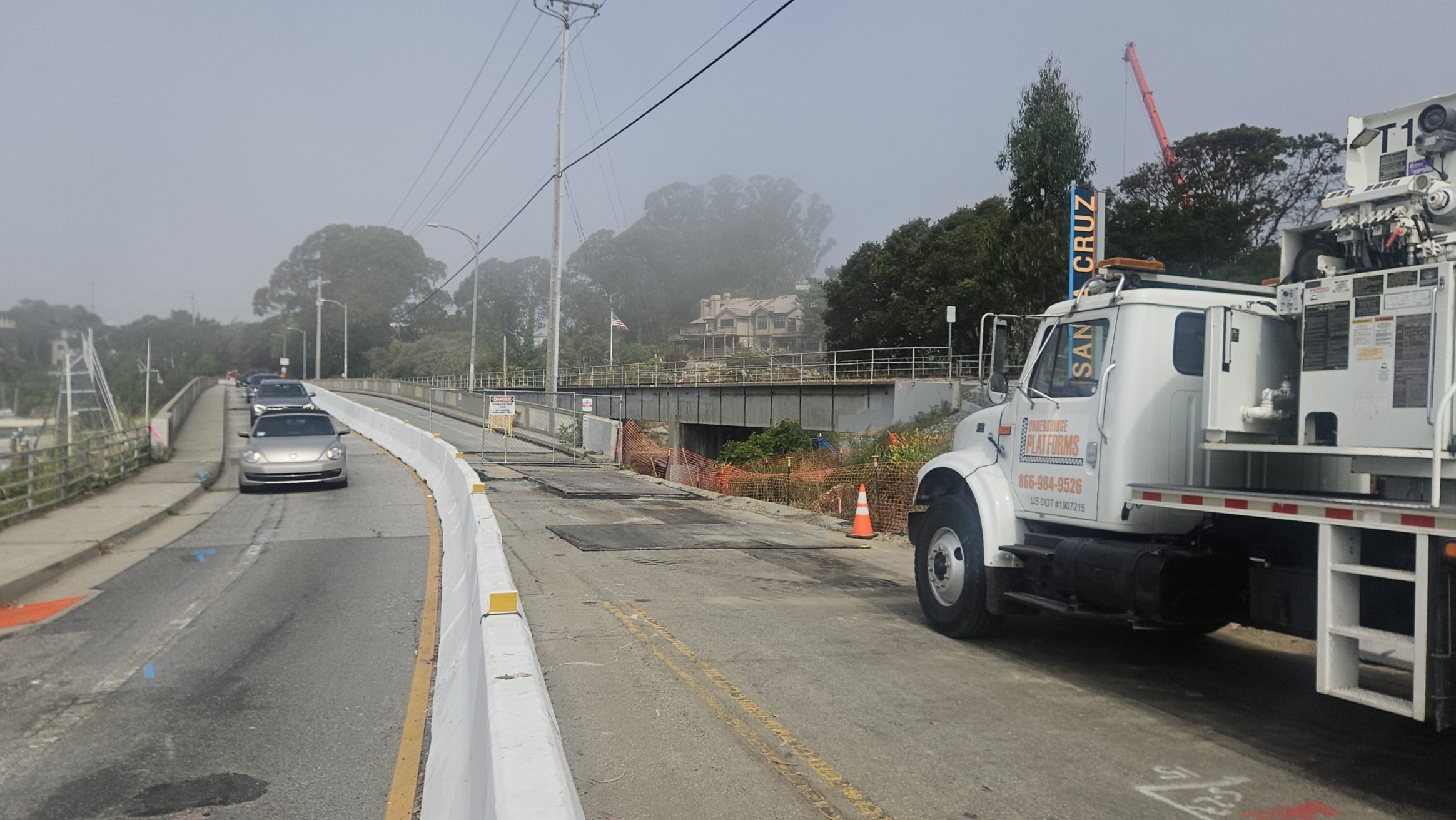
A rail bridge next to the Murray St. Bridge could temporarily open to cyclists and pedestrians. (Tyler Maldonado — Santa Cruz Local file)
Santa Cruz City Council meeting
- 5 p.m. Tuesday, Aug. 12 at 809 Center St., Santa Cruz and online.
- To comment ahead of the meeting, email [email protected] by 5 p.m. Aug. 11.
SANTA CRUZ >> A railroad bridge next to the closed Murray Street bridge may temporarily open for bike and pedestrian traffic as part of an effort to save flagging businesses near the Santa Cruz harbor.
Thursday, the Santa Cruz County Regional Transportation Commission unanimously voted to allow the City of Santa Cruz access to the Santa Cruz Rail Line Bridge across the harbor for a potential temporary walking and biking path.
The city would need permission from Progressive Rail, which owns the Santa Cruz Branch Rail Line, but does not use it north of Watsonville. The Santa Cruz City Council is set to consider pursuing a temporary path on the rail bridge at its Tuesday meeting.
Murray Street Bridge partially closed to traffic in March, and closed entirely June 23. It is set to reopen in February 2026 for eastbound cars and bicycles and two-way walking, then fully close again for three months in 2026. The repairs are set to finish in 2028. A trail over the rail bridge would then be removed.
The sudden drop in visitors to the harbor area since the bridge closure has been “devastating” for local businesses, said Patrice Boyle, owner of restaurant La Posta. The restaurant is on Seabright Avenue several blocks east of the closed bridge.
“We will go out of business if we don’t get help,” Boyle said at Thursday’s meeting. A petition she started to open the rail bridge had garnered 1,360 signatures as of Thursday.
Santa Cruz Mayor Fred Keeley and Santa Cruz County Supervisor Manu Koenig brought the proposal as an emergency item in a special session.
“Looking from 7th Avenue over to the harbor, it’s a ghost town,” Koenig said. “There’s not a soul walking on the street, no one driving, no one biking.”
Some advocates have said the commission should pursue railbanking, a legal process that removes the obligation to keep the rail tracks in place, in order to place a more permanent trail. The proposed temporary trail would not require railbanking, said Sarah Christensen, transportation commission executive director, in an interview.
Passenger rail report
A final conceptual report for a train on the Santa Cruz Branch Rail Line is scheduled to be considered at a December transportation commission meeting.
Thursday, transportation commission staff presented a draft report and information on a potential sales tax increase needed to pay for rail construction. No vote on the project was taken.
According to the reports, a train could include:
- A construction cost of $4.3 billion, with estimates ranging from $3 billion to $6.4 billion.
- Travel times of 45-70 minutes between Natural Bridges and Pajaro, including nine stops.
- 4,200-5,300 projected daily boardings on weekdays in 2045.
Construction could be up to 80% funded by federal and state grants, transportation commission staff have said. Depending on the local match, the train could require a new sales tax of 1.5% to 2.5% to raise $84.4 million to $126.5 million annually, according to the financial analysis. A sales tax would require 66% voter approval.
To be competitive for state and federal grants for rail, about half the commission’s annual discretionary money would need to go toward the project, transportation commission staff have said. About $5 million to $9 million of the transportation commission’s annual budget are discretionary and can be used for any purpose. In recent years, most of that money has gone to projects on Highway 1, Christensen said.
“We’re looking at that level of commitment in order to see this project come to life,” she said.
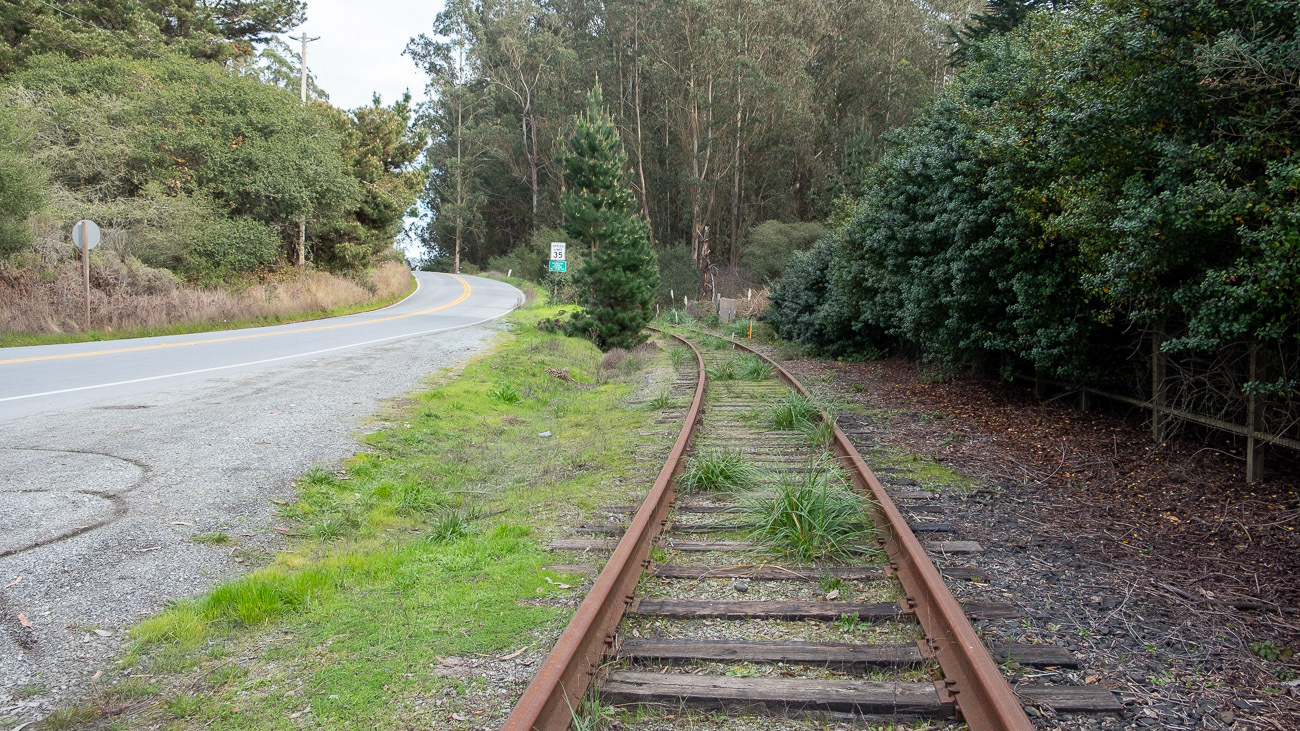
The tracks on the Santa Cruz Branch Rail Line would likely need to be replaced for a passenger train, according to a June report. (Nik Altenberg — Santa Cruz Local file)
Scotts Valley City Councilmember Steve Clark said that commitment could mean leaving other transportation projects by the wayside. “The state and the feds, they want to see that we’ve got some serious skin in the game, that we’re serious about moving forward with this project, and that’s going to take a substantial commitment for us locally,” he said. “It means some sacrifice.”
Santa Cruz County Supervisor Kim De Serpa, who represents Corralitos, Freedom and the Aptos Hills, said that rural residents not near the coast “get little to no benefit” from the train, “yet will have to shoulder the burden of increased sales tax anyway.”
The final report due in December is set to include more details on a proposed stretch of rail trail from Aptos to Watsonville. Commissioners also requested more information about potential requirements from the California Coastal Commission and an outside review of project costs.
Two commissioners indicated their continued support for rail planning for the benefit of commuters in and around Watsonville.
“Transportation is one of the highest household expenses in South County, especially for working families,” said Santa Cruz County Supervisor Felipe Hernandez, who represents most of Watsonville and areas northeast. “Watsonville deserves investment, not isolation.”
Watsonville City Councilmember Vanessa Quiroz-Carter, who represents Santa Cruz Metro on the transportation commission, said that although she is concerned about the potential sales tax, she remains supportive of the project as a daily commuter.
“It does really, really help people like me,” she said. “Yes, we might be spending a little bit more [on fares]. I spend already $100 in gas, easily, per week. Probably $200.”
The commission heard about half an hour of public comment.
Attendee Fabian Leonor echoed Hernandez’s and Quiroz-Carter’s comments, and said the commission should consider the perspectives of younger residents.
“I’m looking around here, most of us are all over age 40 or 50,” said Leonor, who also serves as Quiroz-Carter’s alternate for the commission. “I talked to a lot of Watsonville folks. I talked to young people. They want public transit and they want rail service.”
Others said the high price of rail should kill the project. “I read the report, and I do not see how it presents a case for proceeding with a rail project of this magnitude and expenditure,” said Scotts Valley resident Greg Kassner. “If we did have 5,000 riders a day, that is a shockingly low number to spend $4.3 billion on.”
After the final report is presented, commissioners could vote to move forward with environmental review, which would cost $12 million to $14 million, or abandon plans for rail service.
Questions or comments? Email [email protected]. Santa Cruz Local is supported by members, major donors, sponsors and grants for the general support of our newsroom. Our news judgments are made independently and not on the basis of donor support. Learn more about Santa Cruz Local and how we are funded.

Jesse Kathan is a staff reporter for Santa Cruz Local. They hold a master's degree in science communications from UC Santa Cruz.