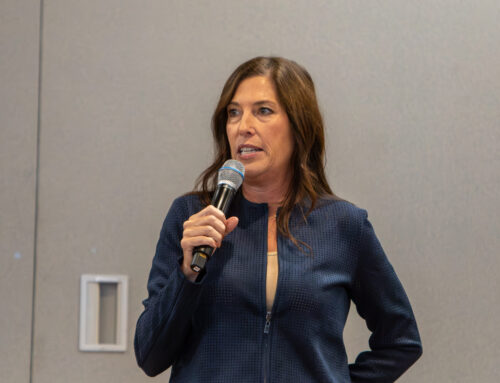

The Pajaro Valley Health Care District board of directors meets on March 25. (Amaya Edwards — Santa Cruz Local/CatchLight Local)
WATSONVILLE >> As Watsonville Community Hospital continues to confront a grim financial outlook, the details of how it might partner with a larger health care system to stay open remain unclear.
The hospital faces an acute shortage of cash, contributing to its financial challenges that were precipitated primarily by last year’s Republican-backed budget reconciliation bill. The One Big Beautiful Bill Act slashed roughly $1 trillion for government health insurance in part to fund bigger immigration and military budgets and offset tax cuts that largely benefit billionaires.
Watsonville Hospital and many rural hospitals across the country are being hit hardest by the cuts as they have a greater share of patients that have Medicaid or Medicare.
Leaders of the Pajaro Valley Health Care District, which operates the hospital, began working on a solution late last year — to seek a partnership with a larger health care system that can take over the hospital’s finances and operations to allow it to stay open even as it loses millions of dollars a year.
“We’re very close, and talks have been positive, and also nothing is set in stone right now,” said district board chair Tony Nuñez, who is also running for the Santa Cruz County Board of Supervisors.
Nuñez said he is optimistic the district will be able to find a partner that allows the hospital to stay open and maintain its guiding principles, including that the public maintains ownership of the hospital buildings and land and services are not cut.
Hospital leaders have said they are exploring potential partnerships with health care systems that already have local ties, including Salud Para La Gente, Sutter, UC San Francisco and CommonSpirit, which operates Dominican Hospital.
At the March 25 meeting, however, Nuñez said they were “casting the net a little bit wider.”
In the meantime, the hospital continues to face a shortage of cash needed to pay staff and keep the doors open.
The hospital ended February with $5.8 million in cash on hand, or roughly 14 days of expenses. That’s after receiving a $6 million advance payment from the Central California Alliance for Health. The money is owed to the hospital from the Centers for Medicare and Medicaid Services but the federal government is nearly a year overdue in doling it out.
“We should have a carrying balance of $40 million — as a floor,” said board member Marcus Pimentel at the meeting.
To make ends meet amid the cash deficit, the district has taken out several short term loans since January, including a $2 million loan from local nonprofit Community Health Trust of Pajaro Valley that must be repaid by July 31.
When asked how long the hospital could continue to operate without a partner organization, Nuñez declined to give an estimated timeframe, but said “we have to move really quickly.”
Glenn Melnick, an expert in hospital finance and a professor at the University of Southern California’s Price School of Public Policy, said Watsonville Hospital’s predicament is not unique.
“Unfortunately this is not an unusual topic for rural hospitals in trouble, and I think we’re going to see more rural hospitals in trouble,” Melnick said.
Small hospitals are less able to absorb years of financial hardship because they have a smaller budget, he said, and they are more susceptible to changes at the federal level because they have a high share of patients on Medicaid.
As far as how long a hospital can continue to operate, he said, “at some point, if you don’t have cash, people can’t come to work. They won’t come to work. And so that is kind of the ultimate constraint.”
Nuñez said the hospital has many supporters, locally and at the state level.
“If we do need assistance in the short term,” he said, “people will help us out.”
Amaya Edwards contributed reporting.
Questions or comments? Email [email protected]. Santa Cruz Local is supported by members, major donors, sponsors and grants for the general support of our newsroom. Our news judgments are made independently and not on the basis of donor support. Learn more about Santa Cruz Local and how we are funded.

Nik Altenberg is a bilingual reporter and assistant editor at Santa Cruz Local. Nik Altenberg es reportera bilingüe y editora asistente para Santa Cruz Local.