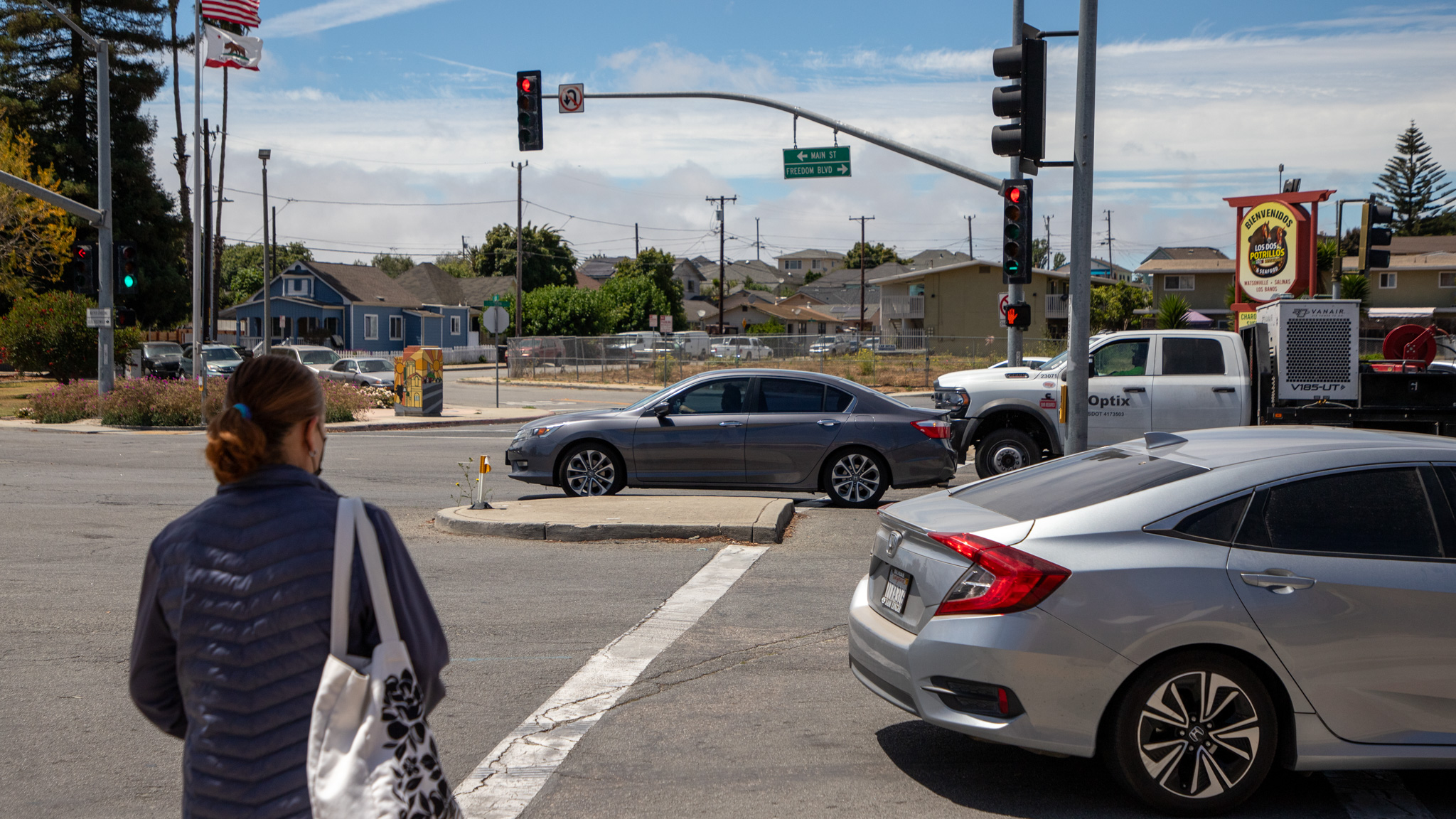
A woman waits to cross the street at Main Street and Freedom Boulevard in Watsonville. (Amaya Edwards — Santa Cruz Local/CatchLight Local)
Give input on the Vision Zero Corridor Study
- City staff are collecting public feedback through Feb. 27 on the potential changes to Watsonville’s Freedom Boulevard through an online survey.
- Read more about the plan and submit feedback.
WATSONVILLE >> Watsonville City Council members expressed reservations Tuesday about reducing the number of driving lanes on Freedom Boulevard as part of a possible redesign to make the thoroughfare safer for cyclists and pedestrians.
Freedom Boulevard is one of Watsonville’s most dangerous roads. The city recorded 109 collisions there from 2019 to 2023, nine of which resulted in serious injury or death.
“If we keep our streets the way they are, we will keep our collision rates the way they are,” Murray Fontes, the city’s assistant public works director, said at Tuesday’s city council meeting. “If we want to improve safety on city streets, we need to make changes.”
The city council was providing feedback on a draft Vision Zero Corridor Study, among the steps being taken toward a goal of eliminating traffic fatalities and serious injuries by 2030.
Watsonville remains one of the deadliest cities in California for cyclists and pedestrians, who die at a rate 70% higher than the county average, according to a Santa Cruz Local analysis. Since 2008, some 30 people have died walking or biking on Watsonville’s streets.
The study proposed a number of traffic-calming measures on Freedom Boulevard, including narrower car lanes, curb extensions and a new roundabout near the intersection with Miles Lane and Lincoln Street. It also called for separated bicycle lanes, pedestrian refuge islands and other new medians, signal timing improvements and added sidewalks, crosswalks and stoplights.
City councilmember Casey Clark said he agreed with some things in the draft plan, like crosswalk and sidewalk improvements. But he called it “poison” to reduce the number of driving lanes on Freedom Boulevard from four to two. Many of the businesses along Freedom Boulevard are “livid about this,” Clark said, adding, “Watsonville, unfortunately, is always going to be vehicle-centric.”
Mayor Kristal Salcido and councilmember Ari Parker likewise aired doubts about lane reductions. Salcido, who commutes by car daily to downtown Santa Cruz, said that after dropping her children off, “I don’t have an extra 15 minutes in the morning to sit in additional traffic.”
No traffic study has yet been done on the proposed lane reductions. City staff say that maintaining all four lanes on Freedom Boulevard would jeopardize the installment of separated bike lanes.
Jenni Veitch-Olson, a Watsonville planning commissioner, said she was concerned about some of the council members’ comments about the proposed redesign.
“When somebody says, ‘I’m absolutely not willing to consider reducing lanes at all because I don’t see the data,’ what I hear is, ‘I’m willing to keep things exactly the way they are, and to continue to have people hurt and killed in town,’” Veitch-Olson said.
Councilmembers Maria Orozco and Vanessa Quiroz-Carter largely expressed support for the draft plan. “All of this has been proven to actually work,” Quiroz-Carter said. “It takes time because people have to get used to it.”
She added that more pedestrians on Freedom Boulevard might be a “really good thing for businesses.”
City staff and local nonprofit Ecology Action are collecting public feedback through Feb. 27 on the potential changes to Freedom Boulevard through an online survey. Read more about the plan and submit feedback. Outreach is also being made to the planning commission and the police and fire departments.
Even if a final Vision Zero Corridor study is approved when it comes back to city council for a vote on April 14, none of the proposed changes to Freedom Boulevard are guaranteed. But Fontes, the assistant public works director, said the study positions the city to secure future funding for design and construction. The study was paid for by a grant from the California Department of Transportation.
Unlike other cities in Santa Cruz County, Watsonville has multiple streets with a speed limit at or above 40 miles per hour. In addition to Freedom Boulevard, Airport Boulevard, West Beach Street, Green Valley Road, Main Street and East Lake Avenue are all collision hotspots.
Research shows that lower driving speeds save lives. A pedestrian hit by a car going 20 miles per hour has an 8% likelihood of death, whereas a pedestrian hit by a car going 40 miles per hour has a 46% likelihood of death.
Freedom Boulevard is not the only Watsonville road being eyed for safety improvements. Some lanes on other streets are being narrowed, and bike lanes and crosswalks are being added, particularly near schools. Additionally, the city began accepting bids earlier this month on a long-planned pedestrian overpass of Highway 1 near Pajaro Valley High School.
Questions or comments? Email [email protected]. Santa Cruz Local is supported by members, major donors, sponsors and grants for the general support of our newsroom. Our news judgments are made independently and not on the basis of donor support. Learn more about Santa Cruz Local and how we are funded.

Jesse Greenspan is a freelance journalist who writes about history, science and the environment. His work has appeared in The New York Times, Scientific American, Audubon and other publications.