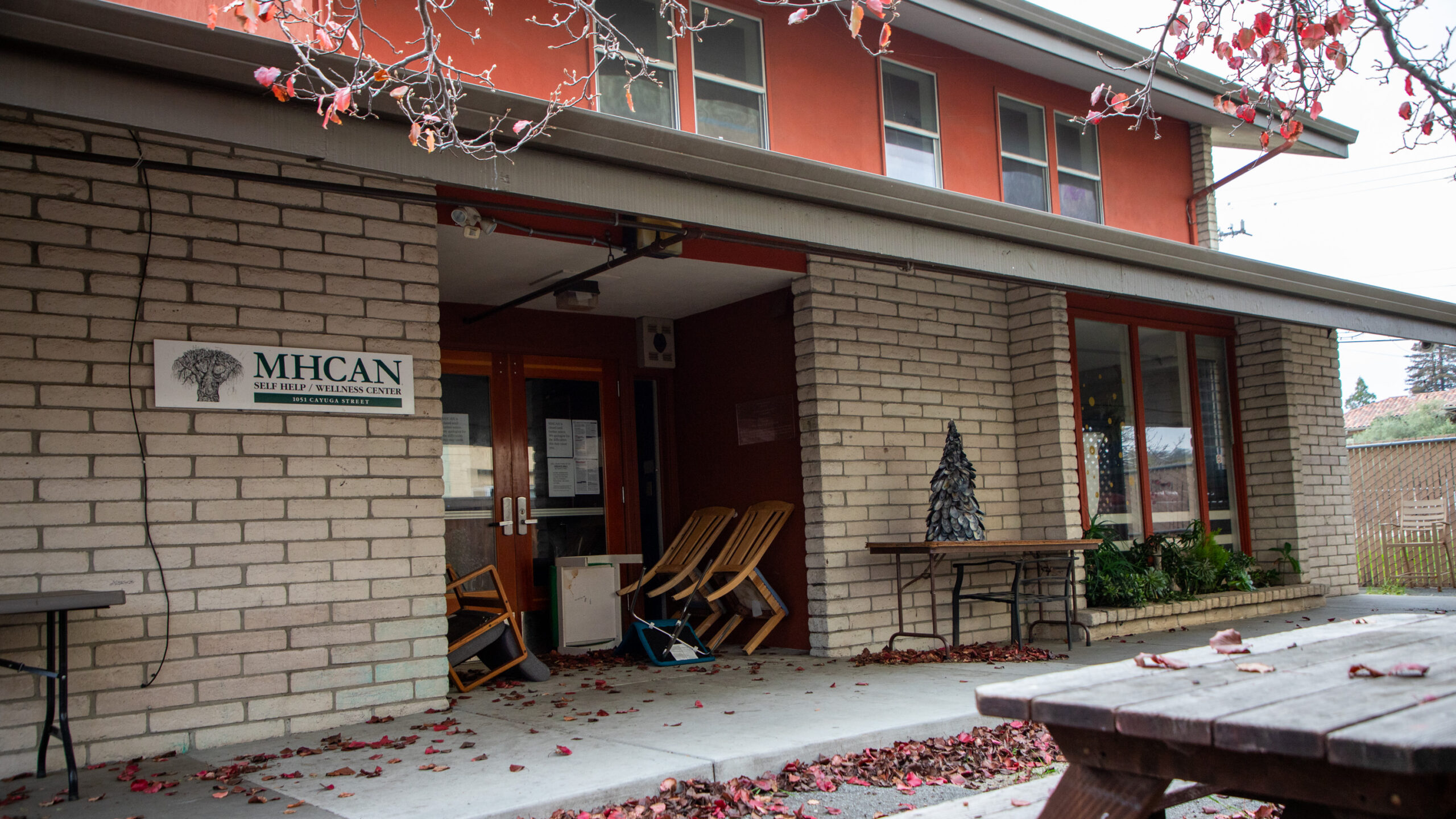
The Mental Health Client Action Network clubhouse has been shuttered since August. (Amaya Edwards — Santa Cruz Local/CatchLight Local)
SANTA CRUZ >> After two weeks of living on the streets, Ari Hutchison is running ragged. He has spent nights alternating between hotel beds and a sleeping bag on Downtown Santa Cruz sidewalks and doorways, in an effort to preserve his meager savings.
It’s not his first bout of homelessness. But this time, at 44 years old, it’s taking a greater toll on his body. His chest has been in near-constant pain from pericarditis, an inflammation of the heart lining that he said flares with stress, and he has been feverish and coughing for a week.
“The first time, I pulled myself out (of homelessness) by sheer will,” he said. “This time, it’s like I can’t even handle being cold.”
Six months ago, things were different for Hutchison. For nearly five years, he lived and worked in midtown Santa Cruz at the nonprofit Mental Health Client Action Network.
For over 50 years, the space was run by and for people with mental illness, and helped them with food, health care and social connection. It is partially funded by Santa Cruz County Health Services Agency, and private donations. In the summer of 2025, it abruptly shuttered amid deep financial difficulties. Nearly six months later it remains closed, and its future uncertain.
As a member of MHCAN’s night watch, Hutchison cleaned the clubhouse and attended to after-hours visitors, many with severe mental illness looking for help. He lived on site, and his savings slowly grew. He planned to eventually rent his own home.

Ari Hutchison takes a photo of his reflection in a Pacific Avenue storefront. He asked that his face not be identifiable in a photo. (Ari Hutchison — Contributed)
Then, in July, the paychecks stopped coming. A month later, MHCAN’s executive director was fired by the organization’s board. And finally, in November, the organization’s board of directors told Hutchison and three other employees living in the building to leave.
County health services agency staff are working with the remaining leaders of the organization to untangle its financial issues and re-open the facility. But some former employees and members are left without answers, and without help.
Danette Lawrence, MHCAN’s former board president who is still in talks with the county, has not responded to repeated requests for interviews since November. After an attempt to verify facts for this article, Lawrence wrote in a text message last week, “you can choose to print what you choose, although you have erroneous information. We have no comment at this time.” She did not respond to follow-up questions.
MHCAN’s history
MHCAN was founded in the 1970s as a space where people with mental illness could provide peer support and respite. Members could use a computer, wash their clothes, watch a movie, eat lunch, or just exist.
The clubhouse gave Melissa Williams, a homeless woman who camps around Santa Cruz, a place to go where people didn’t judge her for being different, and communicating in a way others sometimes don’t understand.
“It’s just important, under these circumstances, to just be able to have a place to go to and feel normal,” she said. “The opportunity that was available, I wasn’t anticipating it being taken (away) quite the way that it was.”
In June 2024, longtime executive director Sarah Leonard resigned, and former board member Tyler Starkman took her place. When Starkman came into the role, MHCAN was already working with the county to resolve issues with the organization’s recordkeeping and invoicing. These problems aren’t uncommon for small nonprofits, said county spokesperson Jason Hoppin.
MHCAN also hasn’t filed legally-required tax documents since 2023, records show. Nonprofits are required to file annually to maintain tax-exempt status and for financial transparency.
A year after Starkman took the reins, MHCAN was threatened with a loss of income in April 2025 as the county wrestled with heavy budget cuts. The move wasn’t related to the issues with MHCAN’s recordkeeping or invoicing, Hoppin said. After fierce pushback from residents and MHCAN participants, the county Board of Supervisors ultimately gave the organization a new contract that promised up to $377,939.
But much of that money has not made its way to MHCAN’s coffers. That’s because the county pays the nonprofit after it provides records of clubhouse attendance and contracted services, like helping members sign up for Medi-Cal health insurance.
The nonprofit failed to send multiple county invoices in 2025 that could have earned them hundreds of thousands of dollars. In the summer, MHCAN employees’ paychecks started coming less frequently, said Hutchison and other former employees, until finally, in July, they stopped altogether.

After financial issues and turnover plagued the organization, it shuttered in August and its future is uncertain. (Amaya Edwards — Santa Cruz Local/CatchLight Local)
Former MHCAN member and employee Blair Bareiszis said she joined the board of directors in summer 2025 in an attempt to help fix the organization’s issues. But she and another employee board member were given less information about the MHCAN’s finances than the rest of the board, she said, making it difficult for her to help.
In late August, the board of directors fired Starkman and abruptly shuttered MHCAN. For many members, the loss of the organization was a loss of community.
“There are several people that I can think of that this is the only place that they went outside of their house,” said Bareiszis, who helped other members use the computer lab and apply for welfare benefits.
The stress of the situation began to take a heavy toll on Bareiszis’ health, worsening her chronic migraines, neuropathy, and symptoms of her cerebral palsy, she said.
“The last month or two that I was there, I literally was not even able to really sleep or eat,” she said. In October, she quit the board and walked away from her job of four years.
That fall, Hutchison helped the board contact past donors and raise thousands of dollars with the intention of re-opening the facility. At the time, he hoped that the board could use past documentation to file outstanding audits, and receive enough money to re-open.
Instead, the situation deteriorated. In November, Hutchison learned that the board had lost their liability insurance, and every member of the board resigned — leaving it unclear who was left to manage the organization’s debts, or its building. He also learned that he and three other members who had lived in the building were being kicked out at the end of 2025.
Hutchison saw two of the other MHCAN residents on New Year’s Day as they, like him, left the clubhouse in the rain without a plan. He hasn’t been able to contact them since.
MHCAN is not a legally permitted residence. But members employed as “night watch” to attend to after-hours visitors had long lived in the building, Hutchison said. He moved in in 2019, after months of homelessness in Santa Cruz. He had come to Santa Cruz during what he described as a mental breakdown after contracting Lyme disease in Pennsylvania.
Hutchison has never received a formal mental health diagnosis, he said. But he believes himself to be somewhere on the autism spectrum. He has a knack for photography and playing piano, but sometimes struggles with complex tasks. Many MHCAN members were similarly both gifted and challenged.
“Like, you just heard like Tears for Fears one time, you play Mad World perfectly, but you can’t open a bank account,” he said.
He also struggles with anxiety, which has rocketed since he was kicked out of the building. After being told to vacate the property in November, he first planned to go to Arkansas to live with the husband of a friend. But later, he began to worry that moving would lead to him losing access to health care, especially with his chronic heart problems and a painfully infected tooth he needs to have extracted.
Leonard, the former director, has offered him a room in her new house in Oregon, he said. But first, he’s trying to stretch his savings long enough to stay for a dental appointment — a difficult prospect with no car, few friends, and no idea when he’ll receive the $2,000 in back pay he said he’s owed from working last summer.
Although Bareiszis likewise said she hasn’t received any back pay and hasn’t found a new job, she’s been able to keep her Section 8 housing — for the time being. Her emergency Housing Choice Voucher expires at the end of the year.
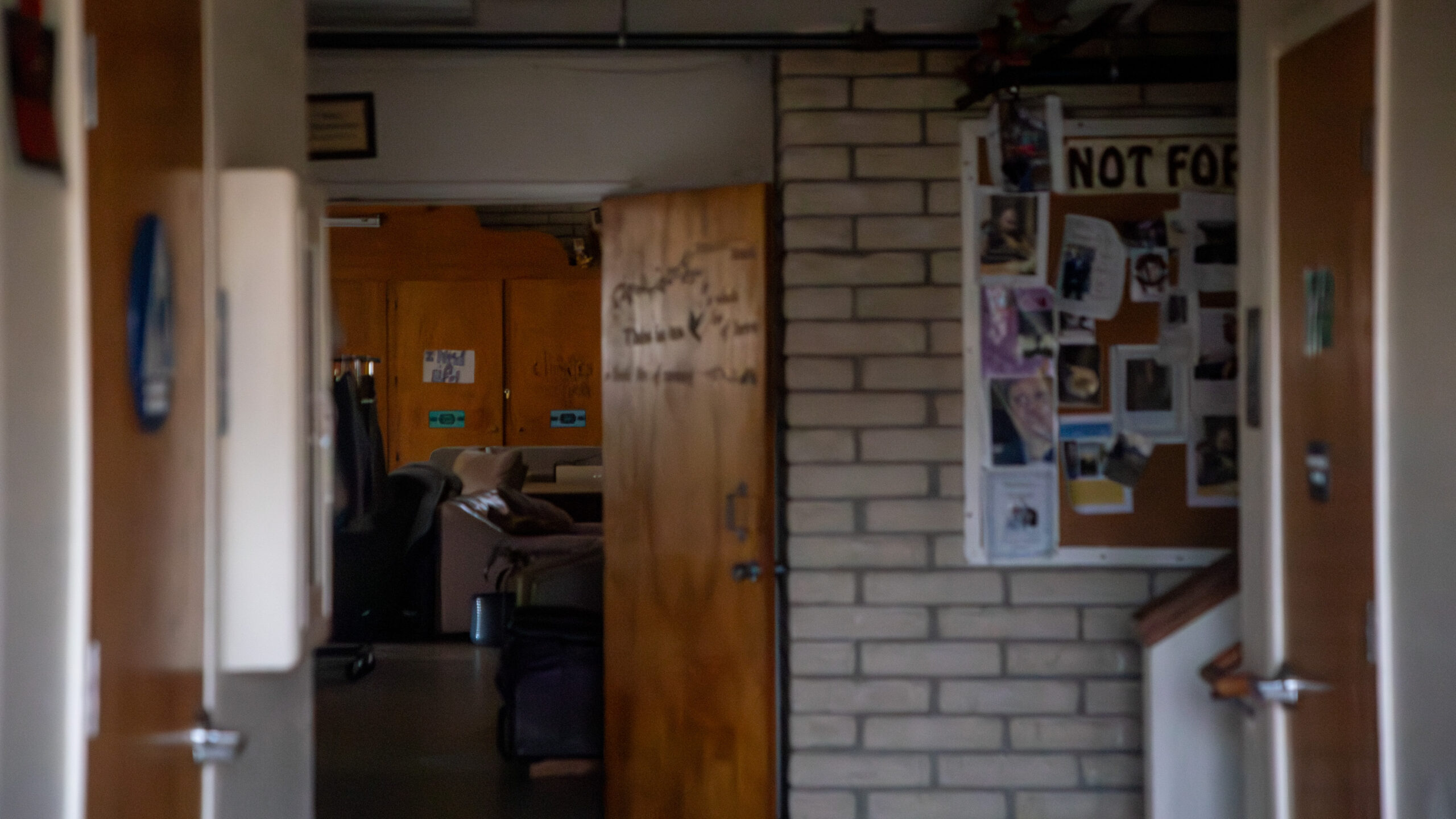
Former board members of MHCAN and local advocates are hopeful that continued talks with the county will lead to a reopening of the organization. (Amaya Edwards — Santa Cruz Local/CatchLight Local)
Next steps for MHCAN
Although board president Lawrence quit in November, it appears she and at least one former board member have re-engaged in talks with the county. It’s not clear who is now leading MHCAN alongside former board president Lawrence. Even Santa Cruz County Supervisor Justin Cummings, who has helped facilitate meetings between the organization and county staff, said he is unsure who is still on the board. Cummings and Hoppin said they didn’t know people had been living in the MHCAN clubhouse. People formerly listed as part of the board did not respond to repeated requests for comment.
Cummings learned this month that the organization has hired a new interim executive director, he said, though he does not know the person’s name. He said he hopes that the county can re-construct the board to include members with more experience in nonprofit operations.
On Dec. 16, county Behavioral Health Director Dr. Marni Sandoval said in a board of supervisors meeting that MHCAN may choose to remain an independent nonprofit. It may also be re-organized with another nonprofit as a “fiscal sponsor” that would help operate the organization’s finances, or have another organization take over the services entirely, she said.
If the organization does remain its own nonprofit, “we’ve already discussed restructuring the board in such a way that there would be someone from the county on the board,” Cummings said. “As much as we appreciate the kind of participant-driven approach that they’ve had in the past, we do understand that if we want to have this be a functional nonprofit, that we do need people in there who have expertise in running a nonprofit.”
Meanwhile, Hutchison continues to ruminate on what he considers the organization’s financial misconduct. He turns over, again and again, the chain of events that left him walking the city with a sleeping bag and a backpack. No shelter he has contacted has offered a bed, and he doesn’t know how long he’ll have to wait for a dental appointment before he can leave town.
His chest is tight. His inflamed heart hurts.
“I really don’t want them to get away with what they did,” he said of the MHCAN board.
Questions or comments? Email [email protected]. Santa Cruz Local is supported by members, major donors, sponsors and grants for the general support of our newsroom. Our news judgments are made independently and not on the basis of donor support. Learn more about Santa Cruz Local and how we are funded.

Jesse Kathan is a staff reporter for Santa Cruz Local. They hold a master's degree in science communications from UC Santa Cruz.