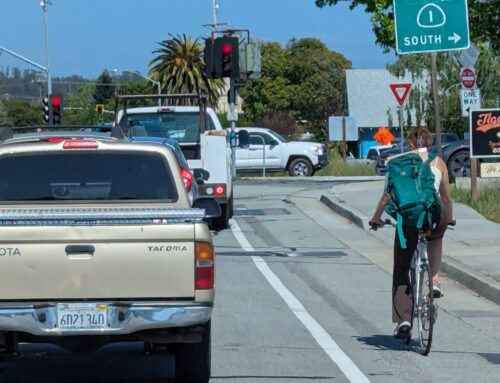
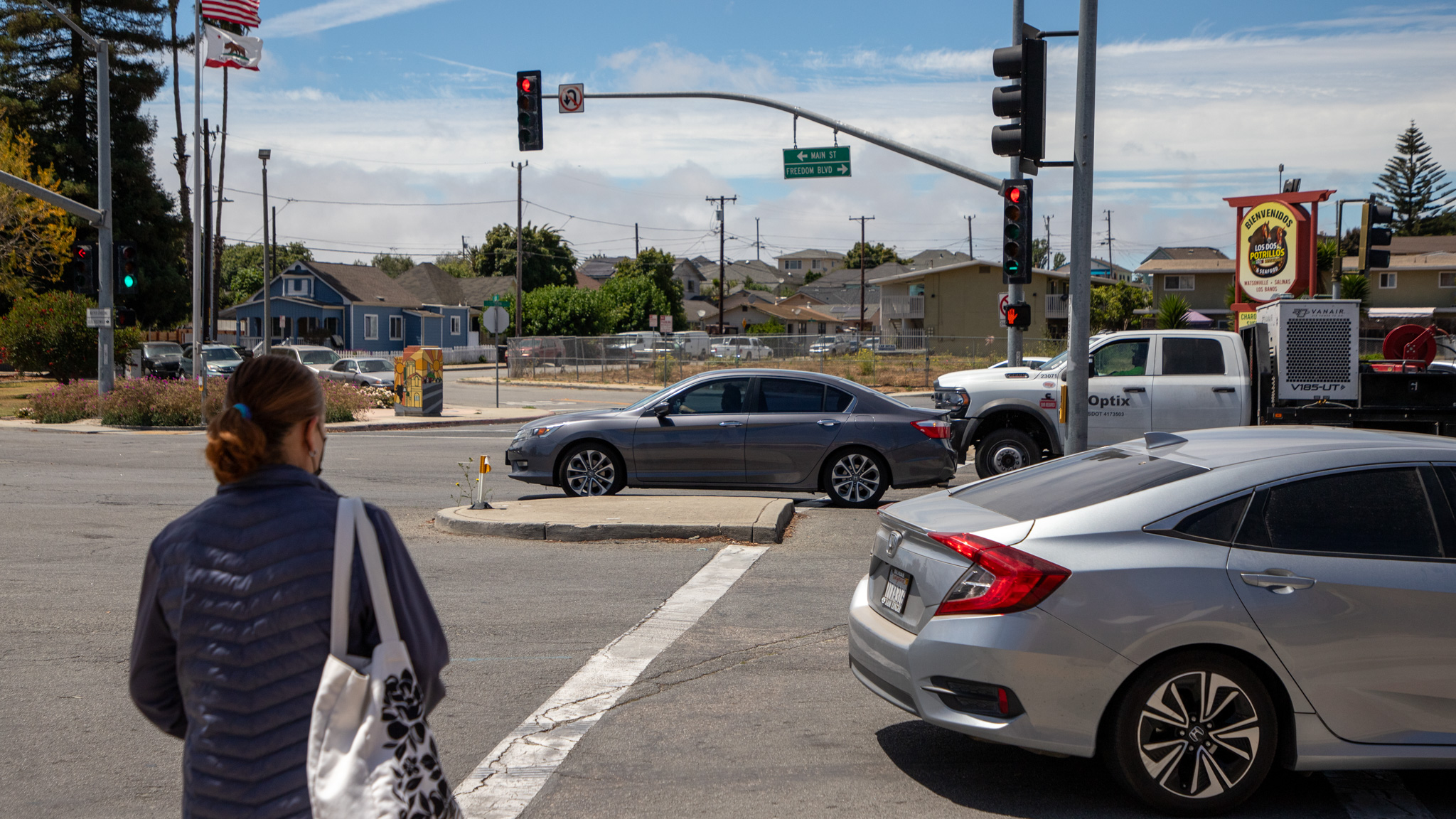
Drivers whiz through a crosswalk at Main Street and Freedom Boulevard in Watsonville. (Amaya Edwards — Santa Cruz Local/CatchLight Local)
Editor’s note: This is the first of two stories about cyclist and pedestrian deaths in Watsonville. Part two explains potential solutions. This reporting is part of an ongoing series on cyclist and pedestrian safety in Santa Cruz County that is supported by a USC Annenberg Center for Health Journalism health equity fellowship. Reporter Jesse Kathan also participated in the center’s engagement initiative.
WATSONVILLE >> After a car hit and killed Geneve Martinez’s mom in September 2017, the message she got from police was that her mom alone was to blame.
Jennie Gervasio, Martinez’s mom, ran a red light biking across Main Street at Auto Center Drive. Like many pedestrians and cyclists killed on Watsonville’s streets, she violated the rules of the road, and lost her life for it.
But Martinez said there’s more to the story: the 19-year old who killed her mom was eventually arrested for speeding on a road with a 40 mph limit. Trees along the road partially blocked visibility. At slower speeds, Martinez thinks the driver might have had time to stop.
Martinez and her family held regular vigils by the crash site, urging police to file charges against the driver. They initially didn’t, she believes, because her mom had a criminal record and had struggled with substance use.
“She was a nobody, that’s what it felt like,” Martinez said. “I had to keep reminding them she was a person.”
Months later, police charged Jesus Castillo with vehicular manslaughter. Court records for the case have been sealed, and Castillo could not be reached for comment.
After Gervasio’s death, Martinez moved away from the Central Coast, and has only returned to Watsonville to visit her mother’s grave. Martinez and her two children remember her as a woman who loved oldies, who loved to dance, who regularly took the bus from her Aptos home to Salinas to care for her grandchildren.
For at least a decade, Watsonville has struggled to keep pedestrians and cyclists like Gervasio safe. People walking and biking on Watsonville streets die at a rate 70% higher than the county average, according to a Santa Cruz Local analysis. That pattern mirrors research suggesting poorer areas with more people of color are more dangerous for cyclists and pedestrians.
Get involved in street safety plans in Watsonville
- Take a survey about potential redesigns for Freedom Boulevard.
- The Community Traffic Safety Coalition of Santa Cruz County and Watsonville Vision Zero Committee meet on alternating months, and discuss bike and pedestrian safety. Sign up for newsletters and notifications of future meetings.
- The Traffic Advisory Commission meets several times a year with city staff to discuss possible road improvements. Sign up for notifications about future meetings.
- Share your thoughts with city staff or Watsonville City Council.
Or, tell us your thoughts and we’ll share them with staff and city council members. You can message us by text, WhatsApp or Signal to 831-291-3456 or email us at [email protected].
And the problem is getting worse — bike and pedestrian deaths per capita in Watsonville doubled from 2010 to 2024. As of 2022, it is on par with Fresno, Bakersfield and Sacramento, some of the deadliest major cities in California for pedestrians.
Since 2008, 30 people have died while walking or biking on Watsonville’s streets. Individually, each death is a tragedy — a lost mother, son, husband, friend. Collectively, they are a public health crisis.
Traffic experts said the problem isn’t just a consequence of personal choices, but a systemic issue that stems from wide roads that encourage high speeds.
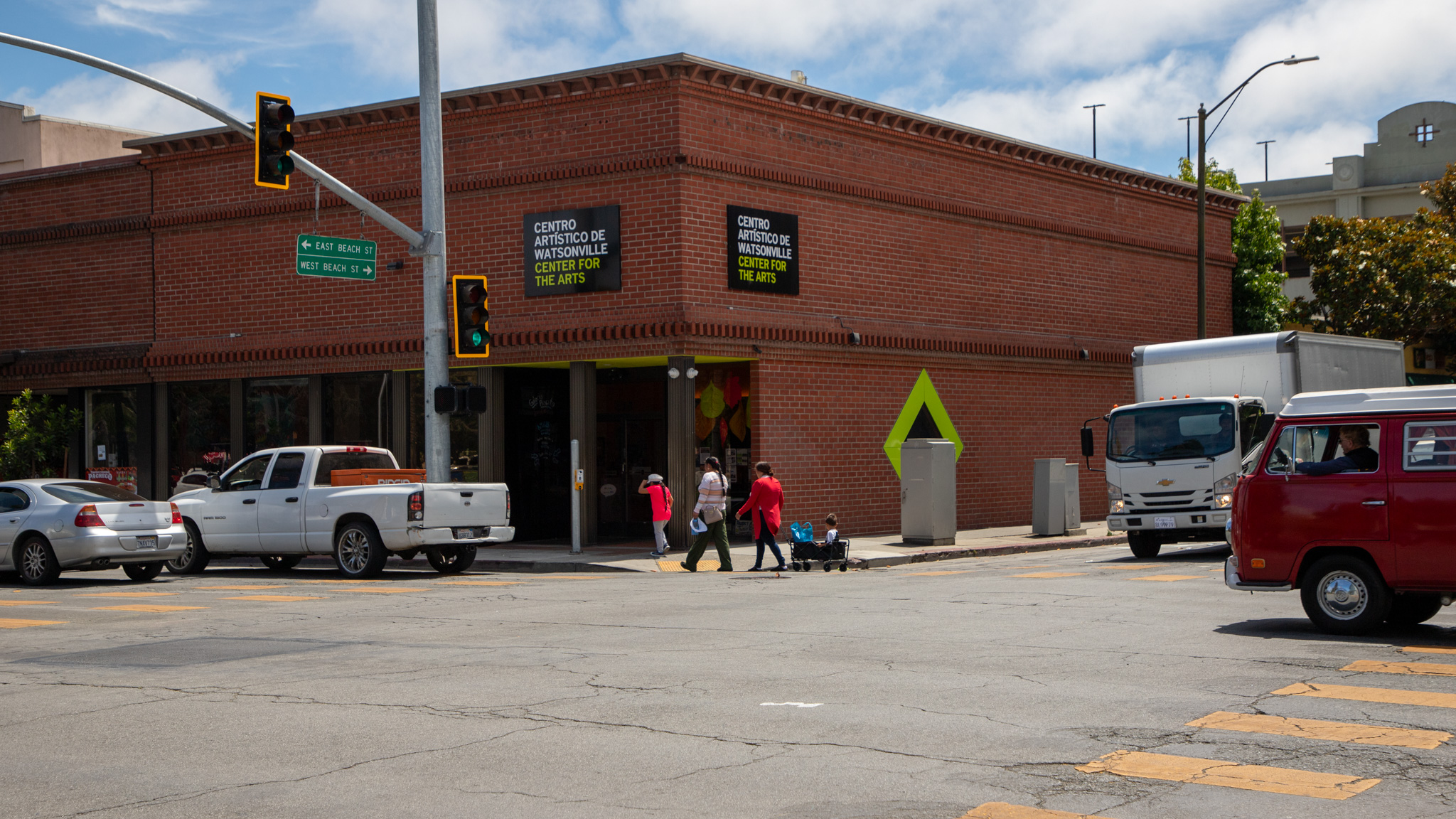
A child in a wagon crosses East Beach Street at Main Street in Watsonville. A 61-year-old woman died at this intersection Dec. 24, 2018. (Amaya Edwards — Santa Cruz Local/CatchLight Local)
Assigning blame
In crash reports, Watsonville police attributed most pedestrian deaths to “pedestrian error,” like jaywalking or not yielding to vehicles. Likewise, cyclists were reported at fault in most fatal bike crashes.
Watsonville Police Capt. Mish Radich said the individual’s decisions, such as speeding, distracted driving and jaywalking, account for most traffic deaths.
Last year, the Rev. Julian Pizarro, Twin Lakes Church pastor, was struck by a car while crossing Freedom Boulevard outside of a crosswalk. He later died from his injuries.
“Had he looked again, or crossed somewhere where he had more visibility, it wouldn’t have happened,” Radich said.
While unsafe behaviors make crashes more likely, vehicle speed makes them more deadly.
Poor choices by drivers, cyclists or pedestrians are “the last event in the chain of events,” said Julia Griswold, director of the UC Berkeley Safe Transportation Research and Education Center. “You’re blaming the human, but the human was put in this situation where that was going to happen.”
At-fault cyclists and pedestrians die at a higher rate in Watsonville than in nearby cities. Since 2013, less than 2% of at-fault Santa Cruz cyclists and pedestrians died, compared with 8% in Watsonville.
Nonprofit Ecology Action is involved in education efforts to teach young people how to walk and bike safely. But Director of Mobility Transportation Matt Miller said responding to fatal accidents requires looking beyond the immediate cause, and instead thinking deeply about how streets shape behavior.
For example, on his bike commute to downtown Santa Cruz, he often sees people jaywalking across Water Street to the county building at Ocean and Water streets.
“The reason they’re doing that is because the nearest crossings for them to go into a crosswalk are several hundred feet in either direction,” he said. The same is true where Pizarro and several other Watsonville pedestrians died while jaywalking.
Jaywalking indicates that streets are poorly designed for walking, Miller said. “People are making judgment calls to cross at points like that, but then it intersects with a road design that’s mostly built to prioritize fast movement of vehicles.”
Deadly road design
The stretch of Main Street where Gervasio died is part of Highway 152. It has four lanes and in some areas, a speed limit of 45 mph.
Martinez, Gervasio’s daughter, grew up on Main Street and has always been wary of crossing it. “It is a straightaway, and people are always just flying through there,” she said.
Since Gervasio was killed, six more cyclists and pedestrians have been hit and killed by cars on that stretch.
Main Street is one of six Watsonville streets with wide lanes and high speed limits in neighborhoods with homes, shops and schools. Combined, these highways and arterials account for the overwhelming majority of cyclist and pedestrian deaths since 2013.
Read part two: Four ways to make streets safer in Watsonville.
The roads were built as Watsonville expanded from the downtown core, said Murray Fontes, Watsonville assistant public works director.
As traffic increased, some streets grew wider.
A city master plan adopted in 1994 recommended wider roads to comply with state mandates meant to prevent congestion. It called for added lanes on Airport and Freedom boulevards and Green Valley Road — all among the most deadly streets for cyclists and pedestrians in the city.
Wide roads encourage people to drive at high speeds, traffic research suggests. But some Watsonville streets also have high speed limits.
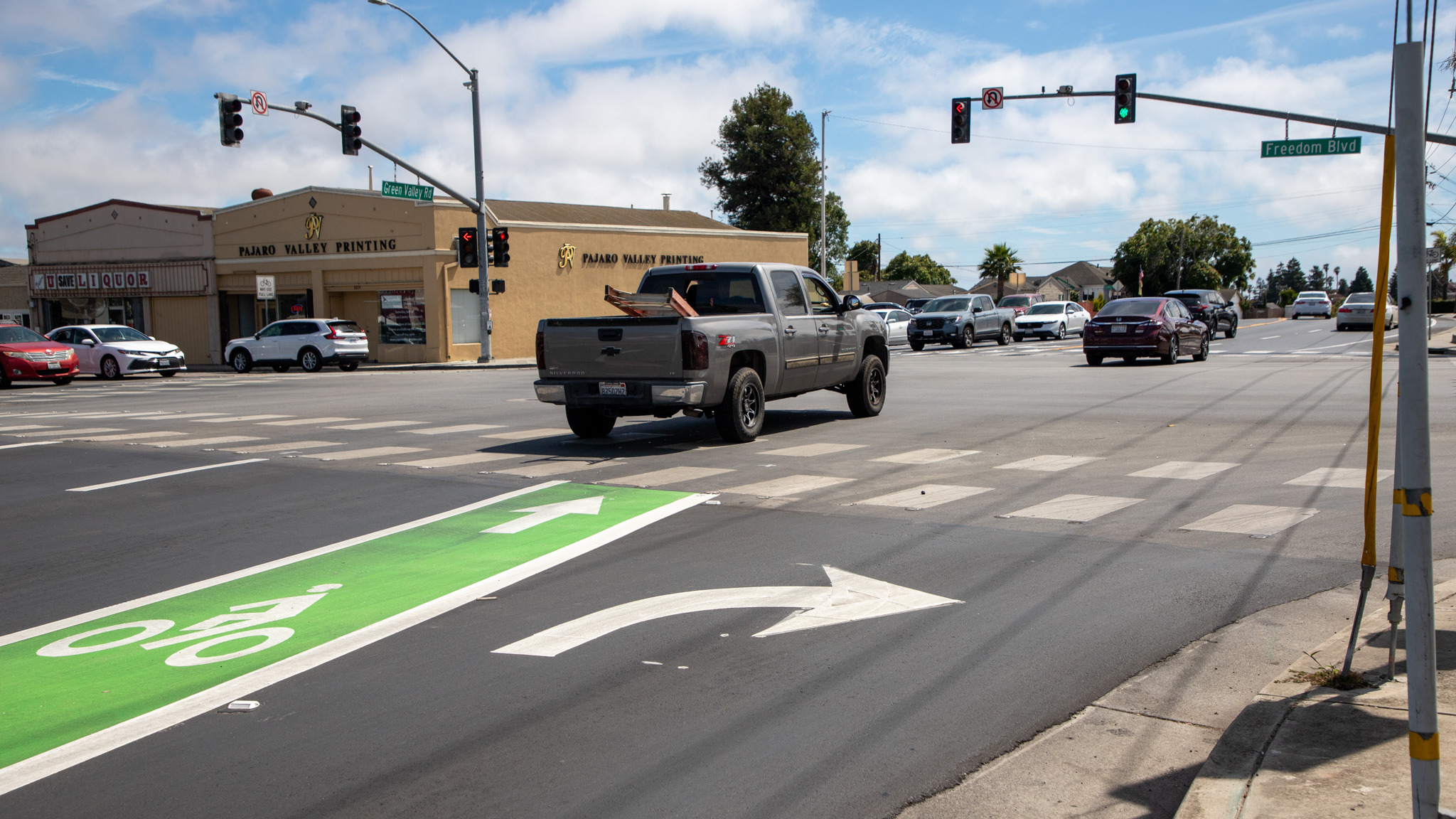
The intersection of Green Valley Road and Freedom Boulevard in Watsonville. Three pedestrians have been severely injured in or near this intersection since 2013, according to state data. (Amaya Edwards — Santa Cruz Local/CatchLight Local)
Unlike other cities in Santa Cruz County, Watsonville has multiple streets with a speed limit at or above 40 mph. They’re relics of a state policy that tied limits to 85% of a road’s average driving speed.
To use radar to issue speeding tickets, state law required the city to increase limits by 5 mph on parts of Airport Boulevard, West Beach Street and Green Valley Road. All of those roads have seen multiple cyclist and pedestrian deaths over the past 10 years.
A mother’s death
In 2022, Marlyn Uribe and her unborn child were hit and killed while crossing Green Valley Road. Mayra Martinez, Uribe’s second cousin, visits her grave every other week.
She said she didn’t know if the driver could have done more to avoid hitting Uribe, who was walking just after sunset. Police did not file charges.
On unlit stretches of Green Valley Road, pedestrians are hard to see, she said.
“It’s happened to me where I’m driving on the road and then all of a sudden you see someone, and then it just happens that they’re wearing all black, and it’s just like, ‘Oh my gosh,’” she said. “Every time something like that happens, the image of Marlyn comes to mind.”
The city should spend more on more crosswalks, crosswalk flashers and street lighting, Mayra Martinez said. She lives next to Freedom Boulevard, where Pizarro and other pedestrians have died, and she often doesn’t let her kids walk the streets.
She often visits Uribe’s grave to remember her soft-spoken cousin, who in younger days accompanied her to the movie theater and the Santa Cruz Beach Boardwalk. On other days, “I usually just stand in front of the picture I have in my kitchen, and just talk to her and ask her to look out for us,” she said.
According to traffic planners and engineers, the simplest way to keep pedestrians and cyclists alive is to design streets where cars move more slowly. But in a city built on car travel, that may not be easy.
For potential solutions, read part two: Four ways to make streets safer in Watsonville.
What do you think?
We will forward your comments on potential street safety improvements to Watsonville city staff.
Questions or comments? Email [email protected]. Santa Cruz Local is supported by members, major donors, sponsors and grants for the general support of our newsroom. Our news judgments are made independently and not on the basis of donor support. Learn more about Santa Cruz Local and how we are funded.
Jesse Kathan is a staff reporter for Santa Cruz Local. They hold a master's degree in science communications from UC Santa Cruz.